Tuesday, September 7, 2021

Performance marketing agency MuteSix bets on content and data to boost DTC e-commerce

Warby Parker filing to IPO last week was one more sign that direct-to-consumer (DTC) is an extremely powerful e-commerce trend. But LA-based performance marketing agency MuteSix didn’t wait that long to build its business around scaling DTC brands.

Created in 2014 and acquired by Dentsu in 2019, MuteSix was recommended to TechCrunch by Rhoda Ullmann, VP Consumer at Sense, a Boston-based startup building a home energy monitor. “They demonstrate best-in-class expertise with Facebook and Google paid ad platforms. They also have a very smart and efficient approach to creative development that was critical to helping us scale,” she wrote. (If you have growth marketing agencies or freelancers to recommend, please fill out our survey!)

Besides Sense, MuteSix’s former and current clients include companies such as Adidas, Petco, Ring and Theragun, to whom it provides a full range of marketing services, including top-notch direct response videos. But regardless of whether you can afford this, we think you’ll learn interesting lessons from our conversation with their CRO, Greg Gillman. The key takeaway? In today’s highly competitive ad environment, both content and data are kings.

Editor’s note: The interview below has been edited for length and clarity.

What can you tell us about MuteSix as an agency?

Greg Gillman

Image Credits: MuteSix

Greg Gillman: We’ve been around for about nine years. We started out as a Facebook ad agency — as opposed to a lot of agencies that start out by saying they do everything, we decided to focus on what we were really good at. At the time, it was doing Facebook media buying for e-commerce companies. Primarily here in LA, which is kind of the hub of these companies, but also all over. And then bit by bit, we grew the organization.

At this point, we’re a little over 400 people, and we manage upward of $500 million in spend on Facebook and Google, including Instagram and YouTube. What we’ve grown into is a one-stop shop for DTC e-commerce companies: We manage all the channels that a DTC brand needs. And we’re a performance agency; everything we do is based on results. People come to us to drive revenue into their e-commerce businesses.

Why do you think that performance marketing is the right fit for DTC?

DTC entrepreneurs are more focused on immediate impact, because if they’re not selling product, there’s no large brand propping them up. So I think that doing DTC marketing requires you to be more performance focused. For agencies that work with large brands, usually it’s more about impression buying versus performance buying. They can say: I did a reach campaign today to hit 10 million eyeballs, and whatever happens happens, because at the end of the day, you just told us to do 10 million impressions. It’s different than working with a group like us that’s trying to optimize every small piece of the funnel, and being accountable for the entire funnel to drive as much sales or revenue.

What type of clients do you work with?

The majority of the companies we work with are digitally native DTC companies. We’ve mostly stayed in that lane, because we’re really good at it. That being said, we work with companies of all sizes — startups, companies that are already established, and very large companies that need to rework both their creative and their media buying strategy.

I oversee sales, marketing and partnerships, and my role is really trying to figure out which brands make most sense to partner with MuteSix. We’re looking for high-growth brands that we can scale, and we’ve learned through the years that what works well are demonstrable products that have cool user value props.

We’ve worked with lots of startups at different points in the funnel, starting from the ground up and working with them through various rounds of funding, all the way through acquisitions, including two by unicorns. But these days, ground up is tougher. I like them to have some proof of concept — putting through $10,000-$15,000 per month on Facebook or $5,000-10,000 on Google usually shows me that there’s some life to it. But I don’t want to limit us if it’s a cool idea. I talk to a lot of people who come back once they’ve proven it out a little bit.


Have you worked with a talented individual or agency who helped you find and keep more users?

Respond to our survey and help other startups find top growth marketers they can work with!


What kind of clients are definitely not a good fit?

It won’t be a fit if there’s no real unique value prop for the product. If it’s just another run-of-the-mill company, a consultant can charge them a lower amount of money and set up Facebook ads, but what we are looking for are high-growth businesses.

The compensation for our campaign managers is actually tied to the performance of the campaigns, so if I bring a bunch of campaigns that we can’t scale, we’re gonna have a lot of unhappy media buyers who ask: “Greg, why would we take on this brand?” It’s a business model that has helped us attract top talent, but we need to make sure that we’re bringing brands that we think we can scale.

And it’s easier than ever to start a company, but it’s tougher now to scale it and take it past the $2 million-$3 million run rate. So I always revert back to asking founders: What are five reasons why people want to buy your product? What are the five reasons that they don’t? If the entrepreneur has trouble answering this, it’s not going to work. If they can’t tell somebody why their business is good, then we’re not going to be good at selling it.

How is MuteSix different from other agencies?

I’d say the main difference is that we have a 70-person in-house video creative team; and what we’re really good at doing is shooting and coming up with performance content. Not just content that looks and feels great, but video that is reverse-engineered to sell product.

Another key component is that we have a whole data science team that is also integrated with our media buying team, and that helps companies navigate things like attribution and signal loss due to the iOS 14 update. Right now, that means focusing on looking at the whole picture rather than by channel and working on mix-modeling attribution.

What are some of the things your data team focuses on?

One of the biggest things that brands struggle with is figuring out attribution, and how you continue to spend money even though you may have lost some signal into the platform. If Facebook skews too heavily, and Google is on last click, then sometimes it looks like things are never working. To help companies make informed business decisions, we are building statistical models that show information at higher-than-the-platform level.

We are also building better segments of customer profiles that help the clients understand who their core audience is, but also helps us build predictive audiences for finding new people.

Another big thing we’re trying to solve is incrementality. We work with large brands that have a strong organic following on social media; and their question is: “Hey, Greg, why should I spend more money if I would have acquired those users anyway?” So we’ve done incrementality testing with brands that spend a lot in other channels than Facebook and Google. We helped them build out different ways to look at the data so that we continue to spend in those channels and they actually know the incremental lift that they’re getting.

There’s one other piece that I think is super important and usually overlooked: first-party data. We work with brands to try and acquire as much of that first-party data as possible, segment it and use it, because that’s what they’d be left with if Facebook shut off tomorrow.

How do you prepare and adapt for changes in the marketing ecosystem?

Because we work with so many brands, we have a lot of senior leadership on each channel level. We routinely meet across departments and share insights. The data science team also builds pretty robust reporting. We try to stay ahead of our brands and to be forward-thinking about anything that is ultimately going to impact the agency. We’re constantly trying to hack our way through things like the types of content that work and things that we know will help us scale.

That’s how we have always approached it. Every major shift in our business was done to answer the needs of the brands that we were working with. For instance, there’s a data side to our business because it’s more important than ever to use that. Facebook used to be a platform where you could throw anything at the wall, and you would get a 4x or 5x return. No one’s asking about data when you’re literally printing money out of Facebook, right? It only happens when the margins get tight. But then Facebook became a more crowded platform, and the same happened with Google: more advertisers, higher CPM and a more competitive environment. We needed to be smarter about what we were doing, so we built out our data team.

Now there’s two levers that we can pull: the data side and the creative side of the business. Again, we are a performance marketing agency, focusing on all the levers. Because platforms like Facebook are only going to be more competitive, they’re only going to get more expensive, and we are only going to lose more traffic. So the more agile agencies have to think much farther outside of what we are doing on these platforms; because we’re going to make up the incremental revenue on things like SMS, influencer marketing and organic content, to continue to drive money into the top of the funnel.

Why is your content arm so important as a lever?

We have an integrated solution where our media buyers are paired directly with our video editors and producers to allow us to be agile and quick; because as everyone knows, content is king. What we try to do is optimize around things like what we call the thumbs-up rate on Facebook — three-second video views. If I held someone for that long in their newsfeed, I can potentially get them into our flow. We do the same on YouTube, and we do things like this on programmatic, because the name of the game is to get people into the funnel and work them through it. And we’re using both our data science team and our creative team to build out and optimize on the front end around these quick metrics to get things moving.

In my opinion, there’s no close second to an SMB agency that has a content arm like we do. Leveraging our content team to build performance content is one of the biggest levers that we have. Three and a half years ago, Facebook was telling us: “If you don’t build video content, and if you don’t prioritize video in the newsfeed, it’s not going to work.” At the time, we leaned in very hard — and the pain of growing a creative team of 70 people is real, especially in LA. But it’s allowed us to scale our agency.


Performance marketing agency MuteSix bets on content and data to boost DTC e-commerce published first on TechCrunch
from Tumblr https://jillfleisher.tumblr.com/post/661689646579908608


Friday, August 27, 2021

Making a splash in the marketing world

“There are three common blunders that most SaaS marketers make time and again when it comes to clarity and high-converting content,” says Konrad Sanders, founder and CEO of The Creative Copywriter, “1. Not differentiating from competitors. 2. Not humanizing ‘tech talk.’ 3. Not tuning their messaging to prospects’ stage of awareness at the appropriate stage of the funnel.”

In an oversaturated market, how can you differentiate yourself? This week in marketing, Sanders took the time to answer that, break down B2B SaaS marketing, and tell us how marketers can do it right. Anna Heim, Extra Crunch daily reporter, interviewed Robert Katai, a Romanian marketing expert, as part of our TechCrunch Experts series. If there’s a growth marketer that you think we should know about, fill out our survey and tell us why!

Marketer: One Net Inc.
Recommended by: The Good Ride
Testimonial: “Exceptional SEO expertise. My e-comm startup relies 100% on SEO traffic and three years ago we were delisted from Google because we didn’t understand about duple content. One Net fixed our site and optimized it for Google, which allowed us to get back into the SERPs. Bottom line is: They saved our business.”

Marketer: Natalia Bandach, Hypertry
Recommended by: Jean-Noel Saunier, Growth Hacking Course
Testimonial: “Natalia is someone with an out-of-the-box approach to growth drivers and experimentation, full of creative solutions and many ideas that she quickly tests through experimentation. Rather than focusing on one area, she tries to verify what makes the most sense to a business and designs experiments that are crucial not only short but also long term. She is an ethical growth manager, likes to know that the business brings real value and is ready to pivot in every direction, [which] she does fast, however, with a focus on the team’s well-being, professional growth and always avoiding burnout.”

Help TechCrunch find the best growth marketers for startups.

Provide a recommendation in this quick survey and we’ll share the results with everybody.

Marketer: Avi Grondin, Variance Marketing
Recommended by: Adam Czach, Explorator Labs
Testimonial: “They have a hands-on approach and worked with my team to not only drive results, but educate us on how we can grow our company further.”

Marketer: Nate Dame, Profound Strategy
Recommended by: Amanda Valle, Adobe
Testimonial: “They offered a robust content research, management and writing platform, which is enabling us to manage, produce and collaborate around our content better.”

Marketer: Oren Greenberg, Kurve
Recommended by: Michael Lorenzos
Testimonial: “He’s the most well-versed growth marketer I’ve met with a wide range of expertise and an uncanny ability to zoom in and out for business context and tactical implementation.”

(Extra Crunch) Are B2B SaaS marketers getting it wrong?: Konrad Sanders, a content strategist in addition to being the founder and CEO at The Creative Copywriter, wrote about SaaS marketing for Extra Crunch. He dove into what SaaS marketers are getting wrong, how to stand out in the crowded industry and the importance of how to approach each section of your funnel. Sanders says, “By creating content for every stage of the funnel, you’ll address your prospects’ concerns at the appropriate point in the buyer journey and increase the chances that when they do come to make a purchase, it’s with you.”

Romanian marketing expert Robert Katai explains how to get the most out of your content: This week, Anna profiled Robert Katai. Katai told her all about Romania’s startup scene and his views on repurposing content. When speaking about using content for carousels on Instagram and LinkedIn, he says, “The first slide should grab attention — it can be a question. The second slide can be a link to the interview so that even if people don’t click it, it will be on their minds. Then you can have slides with insights.” Read the full interview to find out what the third slide should be!

Tell us who your favorite startup growth marketing expert to work with is by filling out our survey.


Making a splash in the marketing world published first on TechCrunch
from Tumblr https://jillfleisher.tumblr.com/post/660715732667088897

Thursday, August 26, 2021

Romanian marketing expert Robert Katai explains how to get the most out of your content

There’s a lot of advice out there on how to grab people’s attention, but there’s one aspect of marketing that Robert Katai thinks isn’t talked about as often: maintaining their attention. The solution, he says, is a combination of content strategy and positioning.

Based in Romania, Katai is known for his podcasts and speeches covering the gamut of content marketing. A product manager at online graphic design platform Creatopy, he also works with clients as a freelance content strategist, and it is in this capacity that he was recommended to TechCrunch via our growth marketer survey. (If you have growth marketers to recommend, please fill out the survey!)

Katai was recommended by multiple Romanian clients and contacts who vouched for his content strategy prowess, so we were curious to know more. Who is he? And is his advice applicable beyond borders?

The short answer is yes. In a freewheeling interview, Katai spoke about how content marketing should integrate with users’ daily lives, and how content can be repurposed across multiple formats. He also shared some insights on the booming Romanian startup ecosystem.

Editor’s note: The interview below has been edited for length and clarity.

TC: How do you help your clients as a freelancer?

Robert Katai: One of the two things I’m doing is that I’m helping clients with creating their content strategy based on their objective. You can get web traffic, but you can also create a message and build the brand. You don’t have to start at the beginning; You can rebuild the brand later.

For instance, I’m working with a Romanian outsourcing company that started in 1993. They pioneered this industry in our city of Cluj-Napoca, but lately they started to realize that they should be more attractive from a sales as well as from an employee perspective. So I worked with them to perform an internal audit to see why employees love the company, why they leave, why they stay and what they want from the company.

Robert Katai

Image Credits: Robert Katai.

From there, I got to the idea that they needed to reshape their brand to not just have people notice them but to also maintain their attention. And here comes the content: I started an ambassador program, because there are people outside of the company who love it.

I also recommended they create an internal print magazine. It’s a very well-designed magazine that their 200 to 300 employees can take home and read. It’s not just about the job; it’s also about their hobbies, things to do in the city and some thought leadership articles that can inspire them to have a better life.

What’s the second way you are helping clients?

Apart from content strategy, I’m working with clients on their positioning for their audience, community and market, but also sometimes in terms of employer branding. Content can be a bridge between the two ways I am helping clients, because I’m using a lot of content marketing here and not focusing only on performance or growth marketing hacks. I’m helping them understand that if they want to establish a memorable, long-lasting brand in the market, they have to make content marketing part of their life.

If they want to reposition themselves in the industry, they need to say: Okay, these are the kinds of content we have to create for our goals; who will amplify the content, who will connect with us, and who will consume the content. Today, content creation is free — everybody can do it. The hard part is how you distribute and amplify that. And here’s how I can help the startups: Make a big piece of content and repurpose it in several small pieces; get it in front of people so that the brand is on their minds.


Have you worked with a talented individual or agency who helped you find and keep more users?

Respond to our survey and help other startups find top growth marketers they can work with!


How can brands achieve that top-of-mind status?

We all know that there are four kinds of content: Text, video, pictures and audio. These four formats never die. The platform can change, but the format will stay the same. A video can be an Instagram Reel, a documentary or something else, but it’s a video. The same goes for a photo. So the content strategy I’m working with is how brands can use that content ecosystem.

When I work with my clients — and also with Creatopy where I’m a product marketer — I recommend them to use content to build their brand and be visible to their users every day in their feeds. Every morning, when their customers are waking up and checking their phones, they don’t open a newspaper. They will open Twitter, Instagram or Facebook, and maybe then when they get out of the bathroom and make coffee, they will open YouTube and connect with Alexa.

I really believe that brands should create content that can just be in the mind of the user. Snackable content, Reels, TikTok … It doesn’t matter what we call it.

You also talked about repurposing content. Can you explain that?

Let’s take the interview you’ve done with Peep Laja. You could have recorded it as a video. And he covered several topics, so you could have several short videos — 30 seconds, three minutes, whatever. You can publish them daily on your site or social media channels with a comment that says, “Here’s the link to the full article.” But remember that on LinkedIn, that link will need to go into the comments section, not the post itself.

You can also have a longer video that you can publish on social media or on Wistia, asking people to give their email — so now you also have subscribers.

Then the second type of content you can create is audio. You already have it from the recording. You don’t have to publish the full 45-minute conversation, but you can have a five-minute audio clip, and again link to the articles.

Now we have video and audio, but what if you also designed quotes with his headshot and messaging? If it’s part of a series, you should also give it a name.

And it’s not just motivational; it’s educational, too, so you should take these quotes and create carousels for Instagram and LinkedIn. The first slide should grab attention — it can be a question. The second slide can be a link to the interview so that even if people don’t click it, it will be on their minds. Then you can have slides with insights.

The last slide will always be a call to action: Asking people to share, comment or save it for later — it’s the new currency on Instagram! And once you have your Instagram carousel, you create a PDF and publish it on LinkedIn.

So now you have five formats of content from one piece of content.

Wow, how much do we owe you?! Just kidding, we actually do some of that for the Equity podcast, for instance. Now, what other advice do you have for startups?

I’m a big advocate of documenting the process. Just imagine if Mark Zuckerberg had done that and you could read how he launched Facebook and so on. Noah Kagan is doing that right now. I think startup founders should do it, not just from the PR and marketing perspective, but for their audience. Even if your audience is not paying for your product right now, they are staying with you and giving your brand an essence in the industry.

Just think about what Salesforce is doing right now: They launched Salesforce+, which is like Netflix for B2B. It’s to get the attention of professionals and also maintain it, and I believe this is the currency of the big companies today: People’s attention.

Do you work with any startups in Romania? And do you have any impressions to share on the Romanian startup ecosystem?

Yes, I help a few Romanian startups with their content marketing and positioning. Sometimes other startups email me with questions, so I help them, too, but I don’t charge for email advice. I work with the ones that are looking for a long-term or project-based collaboration.

Startup founders here in Romania are curious, and very courageous to experiment even if it won’t necessarily work. And Romanian startups are very smart. For instance, Planable is doing a great job with content, social media and positioning. We also have social media analytics company Socialinsider, which this year launched virtual events, and TypingDNA, which wants to get rid of needing to log in with passwords and was founded by a former colleague.

I also found that the founders here work harder than their teams and don’t just leave others do the work — at least the ones I have met. We have several startup events in Romania: How to Web, and Techsylvania here in Transylvania.

I don’t like this name, but people say that Cluj-Napoca is the “Silicon Valley of Romania.” Lots of startups have been launched here, but the city that is getting more and more traction is Oradea, where the bet on education is paying off.

(If you are a tech startup founder or investor in Cluj or Oradea, fill in TechCrunch’s European Cities Survey 2021.)


Romanian marketing expert Robert Katai explains how to get the most out of your content published first on TechCrunch
from Tumblr https://jillfleisher.tumblr.com/post/660606264152358912

Wednesday, August 4, 2021

Hubspot CEO moving to exec chairman role as company promotes Yamini Rangan to CEO

Boston-based CRM company Hubspot announced today that co-founder and CEO Brian Halligan would be stepping into the executive chairman role and CMO Yamini Rangan would be taking over as CEO next month on September 7th.

Rangan joined the company in January 2020 after stints at Dropbox, Workday and SAP. Her strong background in engineering, sales and marketing should prove helpful as she takes over the chief executive role. It’s worth noting that Halligan suffered a snowmobile accident earlier this year, and while he has recovered now, Rangan ran the company in his absence, perhaps helping lay the ground work for this decision  Halligan wrote in a blog post announcing his decision that she is completely prepared to take on this role.

“Yamini has been overseeing day to day operations at HubSpot since March, managing Board meetings, the HubSpot earnings call, and key hiring and growth initiatives, working closely with Dharmesh and the rest of the leadership team. She’s made HubSpot better by being here, and I know that trend will continue with her as CEO.,” Halligan wrote.

Brent Leary, founder and principal analyst at CRM Essentials, who has been following the company since early days, says he isn’t surprised to see a change like this. “With the company recently hitting its 15-year anniversary it really isn’t a huge surprise that something like this is happening. And given all the success they’ve had in growing the company to this point, you have to believe they’ve been preparing for this move for quite some time,” Leary told TechCrunch.

The announcement came as the company released its Q22021 revenue, which looked to be pretty solid coming in at $310.8 million up 53% over the same period last year. The vast majority, over $300 million was subscription revenue with the remainder coming from professional services, a ratio that you would expect for a company like this. The revenue puts them on a nice run rate of over $1.4 billion.

The company was founded in Boston in 2006 by Halligan and Dharmesh Shah and raised over $100 million, according to Crunchbase data. It was an early promoter of content marketing, using quality content, often in the form of company blogs, to drive website traffic and increase sales. It’s something that’s widely accepted now, but when they started the company it was not well known and they helped bring the concept to the mainstream.

Hubspot later moved into a broader CRM platform after going public in 2014. Along with Wayfair, Hubspot is one of the big success stories to come out of the Boston startup scene and go public, helping to fuel the city’s startup ecosystem with the money the founders made on their successful IPOs. Hubspot stock was up over 2% in after market trading on the news, perhaps signaling that investors are pleased with the company’s transition plan.


Hubspot CEO moving to exec chairman role as company promotes Yamini Rangan to CEO published first on TechCrunch
from Tumblr https://jillfleisher.tumblr.com/post/658624440334221312

Tuesday, August 3, 2021

Demand Curve: Tested tactics for growing newsletters

There are very few marketing channels as well rounded as email newsletters. They provide a direct, owned line of communication with your audience; nearly 40x return on investment (~$40 generated per every dollar spent), are infinitely scalable and virtually free.

But to unlock these benefits, you’re going to need to be strategic. In this article, I’m going to share tactics we’ve used at Demand Curve to grow our newsletter list to over 50,000 highly-qualified subscribers and maintain an open rate of over 50%.

Increase popup conversion using the 60% rule

While they’re often thought of as intrusive, pop-ups work. On average, they convert 3% of site visitors, and strategic, high-performing pop-ups can reach conversion of about 10%.

To make higher-converting, less intrusive pop-ups, try the 60% rule.

  1. Choose a page you’d like to put a pop-up on. We recommend pages that aren’t conversion-focused (like product pages, checkout and sign-ups). We’ve found content pages work the best and they can act as a signal for visitors who are looking for something specific.
  2. Open your website’s analytics and see what the average time spent on that page is.
  3. Set your pop-up to appear after 60% of the average time of that page has elapsed.

So if the average time spent on a page is 50 seconds, set your pop-up to appear 30 seconds (60% of total time) after visitors land on that page.

Why 60%? Readers have shown interest in your content, but are nearing the end of their session. Prompting them to join your newsletter to see more relevant content in exchange for their email will feel fair.

To encourage new subscribers to open your welcome email, try breaking the welcome email pattern using delayed gratification and a recognizable sender.

Give samples of your newsletter to prove quality

If a visitor is new to your content, asking them to sign up for your newsletter can be a big step, and most new visitors won’t convert. To narrow the gap between a new reader and subscriber, provide a sample on the sign-up page. Use your most engaging newsletter as a sample to prove that your content is high quality.

To source your most engaging content, filter by open rate and replies. In your email service provider, sort your previous editions by open rate. This will help you identify which subject lines are most popular with existing readers. Modify your most popular subject line to turn it into a header on your newsletter sign-up page.

Next, go into your inbox and sort by replies to your newsletter. Identify which newsletter got the most replies from your readers. This is a positive signal that the content from that edition resonated the most and would be a solid choice for your free sample.

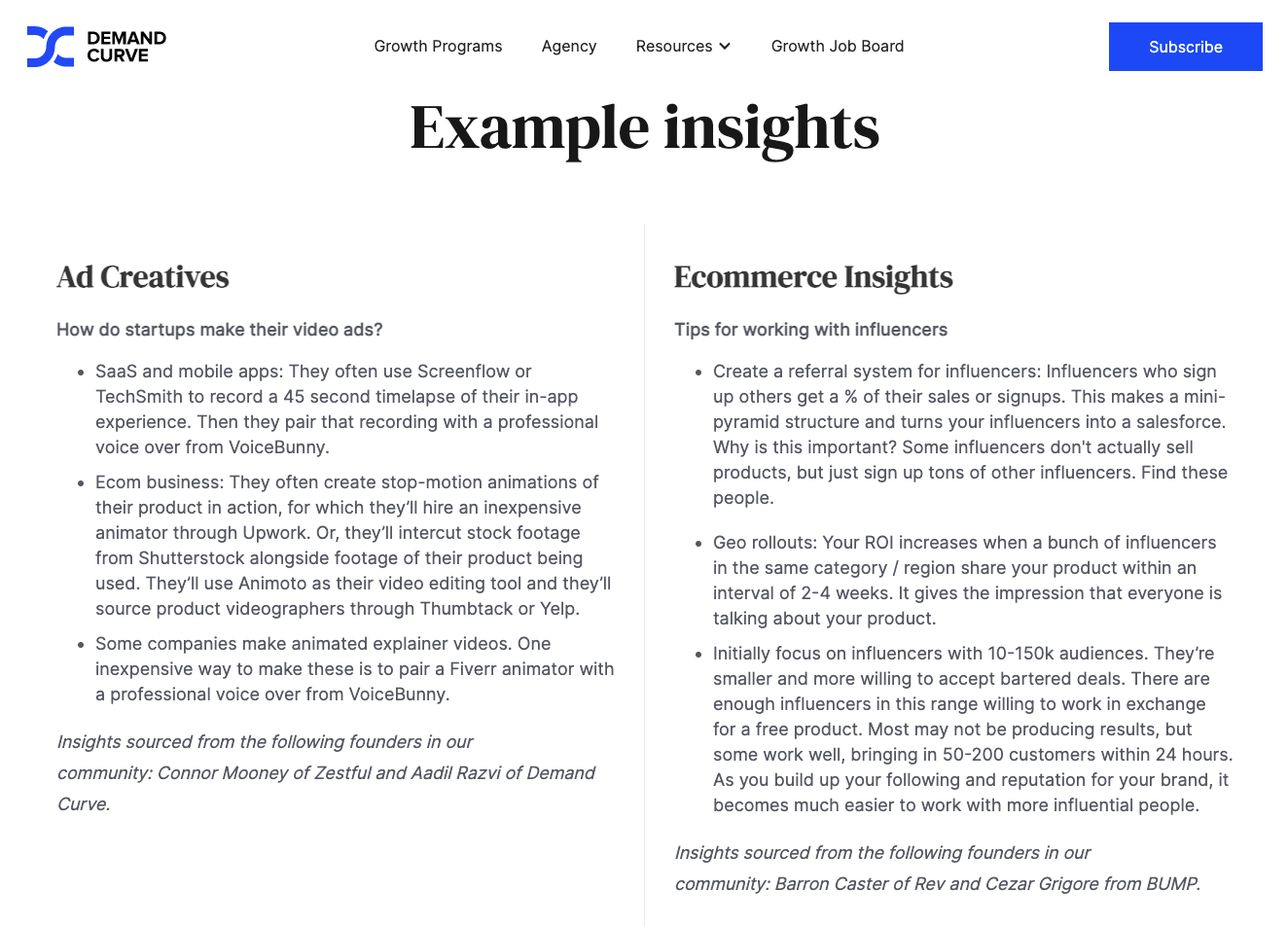
Give samples of your newsletter to prove your quality

Image Credits: Demand Curve

Emails from real people are opened more often

People reflexively ignore welcome emails after they sign up. But, those who do open your welcome email are more likely to consistently open your newsletters.

To encourage new subscribers to open your welcome email, try breaking the welcome email pattern using delayed gratification and a recognizable sender.

Delay your welcome email by 45 minutes. This will bypass the reflex that new subscribers have to ignore an email that pings them seconds after signing up. We’ve found 45 minutes to be ideal, because the delay is long enough that it breaks the pattern, but not so long that your email gets buried in their inbox.

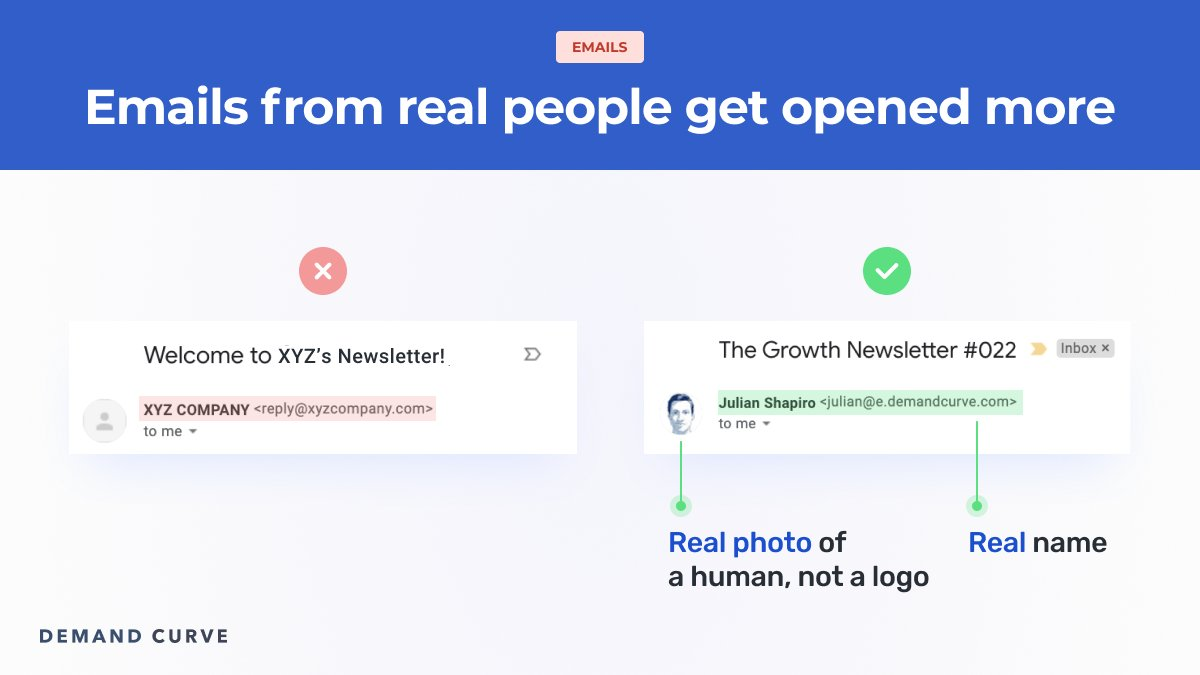
Send your welcome from a person, not from a business account. We’ve found this tactic to be especially effective when the sender is the founder of the business or someone with an established audience. Use a photo of that person and not your company logo to help the email stand out.

To avoid overflowing the sender’s real inbox, create a subdomain for your website that will be used exclusively for sending emails. Create an account for your sender and begin using it for your newsletter. This avoids overwhelming their inbox and maintains the health of your sending domain.

Emails from real people get opened more frequently

Image Credits: Demand Curve

Send a superissue to new subscribers

A new subscriber will be keen to receive their first issue. To ensure they’re satisfied, piece together your best content from past issues into a superissue. But be careful not to use the same content you included as samples on your sign-up page.

Send this first superissue with the welcome email so that your new subscribers are immediately receiving value from your newsletter. Starting with your best content first will get your subscribers excited to open future emails.

We’ve found that shorter welcome emails perform better than long-winded ones. Keep your welcome message short and your opening issue tight. Once they’ve received the welcome email and the first superissue, add them to the regular email cadence.

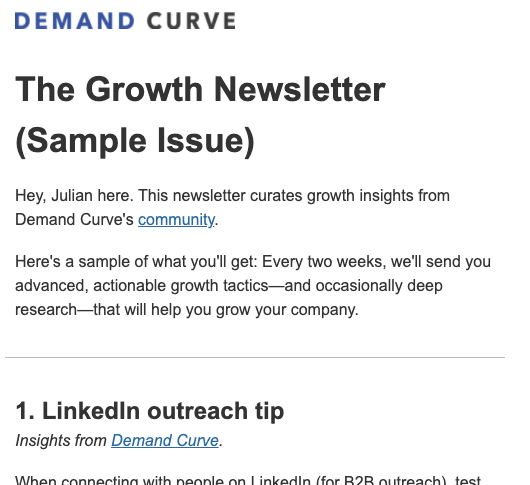
Send a super-issue to new subscribers

Image Credits: Demand Curve

Consider sending fewer emails

We polled over 24,000 marketers on Twitter asking whether people suffer from “newsletter fatigue,” causing them to unsubscribe.

The results: 80% of respondents unsubscribe when they get too many emails.

To avoid overwhelming your subscribers:

Give your subscribers control over how often they are emailed: Some subscribers want them weekly, while others want monthly. In the footer of your email, create opt-out links that allow subscribers to customize the cadence they’ll receive emails. Giving them the opportunity to opt out of frequent emails while still remaining subscribed keeps them as valid contacts on your email list. You want to avoid losing them completely as a subscriber.

Send fewer emails: Putting a constraint on how many emails you’re allowed to send every quarter will force you to be more thoughtful about the contents of those emails. A high volume of emails just for the sake of being in your subscribers’ inbox can burn you and your readers out. We’ve seen very little correlation between volume of emails and the resulting conversion rate.

Make your emails fun — not just educational

Most emails in your inbox are serious. To stand out, consider injecting some lighthearted memes, jokes or interesting links from around the web.

We’ve found this tactic works extremely well, because it gives your readers a dopamine hit in every email. Not every piece of newsletter content you write will resonate with every subscriber. Humor, on the other hand, can have broad appeal. Including interesting and fun content will ensure that every reader is left feeling satisfied.

It also helps build a habit. If every edition is slightly different, your reader will never be sure what they’re opening when a new edition hits their inbox. We’ve found that including something fun at the bottom of the newsletter gives readers a reward: Read the serious stuff, then get rewarded with the fun stuff.

We add a meme to each issue. People reply to tell us how much they appreciate it.

Add a funny meme or interesting content to engage your readers

Image Credits: Demand Curve

Make referrals seamless

Referrals are a free way to grow your newsletter. To increase the chances of subscribers referring you to others, make sure the process takes no longer than 25 seconds.

Remind readers at the end of each issue that they can refer others. A simple way is to ask them to forward the email to a friend who would find it interesting. Include a short sentence in the intro to your newsletter telling people being referred where they can subscribe. Include a link.

An advanced tactic is to include a subscriber’s unique link to a referral program so they can track how many people they’ve invited. Give them the option to share through email or social media.

You should also have a web version of every issue so that your content can be easily shared outside of email. Most email service providers will automatically generate a web link that you can promote through social media or elsewhere. You can also copy the content and post it to your website as a blog post to generate traffic from search engines.

Consider providing rewards to those who refer your newsletter. Merchandise will likely only work as an incentive if your brand is well known or very unique. We suggest incentivizing referrals using exclusive content. Send a monthly bonus issue to subscribers who have referred five or more friends. This will keep your costs down and give your subscribers more of what they already want.

Note that you will need a critical mass of subscribers before referrals will prove to be effective. We’ve found the threshold is about 10,000 subscribers. But if your audience is extremely engaged or the community you serve is active, implementing a free referral program has virtually no downside.

How to turn followers into subscribers

Your subscribers will likely become aware of your content through a social media channel, but social media audiences are rented from the platform — you do not own a direct channel to communicate with them. Converting followers into newsletter subscribers is one way to control a direct line of communication and deepen your relationship with your audience.

When pitching your followers to subscribe to your newsletter, include a link in your bio. This may sound obvious, but many people don’t do it. When someone comes across your social media profile, make signing up for your newsletter the call to action. Otherwise, they’ll have no idea that you even have a newsletter.

You could also cut a Twitter thread or LinkedIn post short and tell people to subscribe for the rest of the insights. You probably don’t want to overuse this tactic.

Create an offer or unique piece of content that can only be accessed through the newsletter. This will motivate your followers to join your email list to get access to exclusive content or unique offers.

Recap

Getting new subscribers: Use pop-ups that are relevant and only to high-intent readers on your site. Provide proof of why they should subscribe to your newsletter with sample content. Make your welcome email stand out and front-load the first issue with your best content.

Keeping subscribers: To keep your subscribers wanting more, send fewer emails. Sprinkle in humor and interesting links to turn your newsletter into a habit.

Promoting your newsletter: Use exclusivity and offers to hook your social media followers into subscribing to your newsletter. Ask your subscribers to refer your newsletter to others to grow your subscriber base.


Demand Curve: Tested tactics for growing newsletters published first on TechCrunch
from Tumblr https://jillfleisher.tumblr.com/post/658530083420717056

Thursday, July 29, 2021

Draft.dev CEO Karl Hughes on the importance of using experts in developer marketing

Developers can be a tough crowd. They typically hate being marketed to and are often short on time, which sets a particularly high bar for any content marketing aimed at them.

Coming up with relevant content that developers find interesting takes specific know-how, and this is where Draft.dev comes in. Its Chicago-based founder and CEO Karl Hughes describes the firm as “a superniche content marketing production company, producing technical content for companies that want to reach software engineers.”

Hughes and his agency were recommended multiple times in our growth marketer survey, which we launched to surface experts that startups can work with. (If you have your own recommendation, please fill out the survey!) One of the survey respondents noted that developers are underrated as a target audience: It may be niche, but it is a large one. More importantly, they are an audience a growing number of startups need to reach.

“If you are going to have subject matter experts write, you also need to have good editors to work with them.”

Developer marketing came up in our conversation with strategic marketing firm MKT1, so we called on Hughes to learn more. Our discussion covered a lot of ground, from what he has learned and his ambitions to Draft.dev’s process.

Editor’s note: The interview below has been edited for length and clarity:

What kind of clients does Draft.dev work with?

Karl Hughes: Almost all of our clients are developer tools companies. Mostly Series A- and Series B-funded, so they have got some funding and some knowledge that content marketing works for their audience. What they are trying to do with us is scale production and make sure that what they are writing is going to resonate with developers.

What inspired you to create Draft.dev?

I’ve been a software developer, and then most recently was a CTO at a startup in Chicago, so I knew that there were lots of companies trying to reach developers [ … ] and that a lot of them were doing a poor job of it. So last year I wanted to combine my tech knowledge with writing knowledge, and that’s where Draft.dev came from — and it’s been awesome!

We get to work both with technical and non-technical marketing and developer relations people to help them get more content out. And even though it’s marketing content, it’s super focused on education, because developer marketing is a bit tricky. Developers can be a bit skeptical of marketing, so you have to be nuanced in your approach. You have to be genuinely helpful, so we really try to focus on helpful content that is also a net positive for the client.

What are some mistakes that you see companies making when creating content for developers?

There are a couple of big challenges that Draft.dev is specifically built to solve: Relying too much on your own team to create content when they are busy and have other priorities, and thinking that you can just get your general copywriting agency to cover developer topics. It usually doesn’t work well.

Many companies start off getting their engineers to write content and make the mistake of thinking this will work forever. Let’s say you’re a continuous integration tool and you want to write content that shows developers how your tool works and that it’s a good option. Marketing teams will go to developers and say: “Hey, could you guys write a blog post?” And they’ll usually get a few blog posts here and there, but it’s really hard to build consistent content when these engineers are building the product and have production deadlines to hit.

When you look at companies that have done developer marketing really successfully, like Okta and DigitalOcean, you see that they have dedicated teams to produce this content. There’s a reason for that: It’s almost impossible to get your engineers to write everything that you need to produce high-quality and consistent content over time.

The other big mistake that I see companies making is thinking that a general marketing writer or SEO copywriter can write great content for developers. That is super rare. I mean, I’ve probably met two or three who can do a decent job of making it look like they know enough to speak with some authority. In general, you either want somebody — either at your company or otherwise — who knows the tool.

So for example, if I ask a general SEO copywriter, “Could you write about how to write a SQL query that does X, Y and Z?”, maybe they can hack some other articles together and come up with something, but it’s certainly not going to have the authority that a real software developer has.

This is true in any area where you have to rely on subject matter experts to help you with marketing content, but because my background is in development, I knew that this was a huge problem for companies.

How does Draft.dev address that?

We are definitely not right for every company. But for companies that are looking to scale-up content production and have technical authority behind those pieces, that’s where we come in. Typically, these are companies that know they want to do developer content, but are stretched too thin on their engineering team or they have tried freelancers and have a really hard time managing them and keeping quality consistent. So they come to us to do that.

We solve that problem with a huge pool of software developers who write for us on the side. Right now we have about 50 or 60 active monthly writers who are all software developers; they work full-time jobs and do this at night and on weekends. We bring people who are actually in the field, doing these things every day. They bring that technical expertise to the articles that we create for clients.

The mutually beneficial aspect here is that while we obviously pay these writers, they also get a byline out on the client’s site. We don’t do a lot of ghostwriting, which is a little unique, but is really good for our style of content because you want to show subject matter expertise. It’s preferable when you don’t have your head of marketing listed as the author of every piece of developer content. It’s nice to have a byline by a real software developer.

All of this goes back to what your content strategy is and who you want to reach. This is not blanket advice for everybody, but for companies trying to reach developers who are writing code every day, I think it’s super helpful to have some technical authority from people actually doing this.

How do you make sure your writers have subject matter expertise?

We have a writer vetting and selection process. Once we have vetted the writers who have applied, we also look for the best match for each article. We are looking through their skills and past experience to see who’d be the best fit.

We also recruit specific writers to write about niche topics. Sometimes that means doing cold outreach; sometimes it means going through our networks and figuring out who we know who’s written about Rust before. Things like that can be really tricky and time-consuming for a marketing team to do, but because we are doing this full time for lots of clients, we can spread that work around. It makes a lot of sense, and our clients like that we do this for them.

How to you balance your writers’ technical expertise versus writing skills?

That is tough! But there are some best practices in this field. If you are going to have subject matter experts write, you also need to have good editors to work with them.

There are two sides to how we get high-quality content from software engineers who may be average writers when they start, and are often ESL speakers. The upfront part is that we plan content pretty thoroughly. We go back and forth with the content to make sure we know what we are producing, and we also have technical content planners who make sure that each article has a story, an outline and lot of structure before we give it to a writer.

The writer fills in the technical details and personal experience, and then every piece will go through three rounds of edits to get it up to our standards: a technical review; a developmental edit for things like structure and flow, and a copy edit.

How do you split these tasks?

We’ve refined this process a lot since starting this [in May 2020]. Initially, it was just me and my managing editor Chris [Wolfgang] — she had a lot of experience in editing, so she could do full-stack editing, and I was focused on writing, picking writers, reviewing, etc. That’s how we divided things in the early days, but as we grew, we realized that we wouldn’t find an army of Chrises and Karls.

We had to figure out how to split these jobs into specialities where people can do their best work, and that’s how we managed to scale and keep quality high while growing at the pace we have. We now have five full-time people and we work with over 35 startups of various sizes, so we are still a small business, but it has been growing very quickly.

How do you get new clients?

Our biggest source of new business has been referrals. Clients who work with us love what we do and refer us to other people. We have also ended up working with companies going through accelerator programs like Y Combinator, so when new YC companies ask who does developer content, they hear about us. Besides us there’s probably just a couple of other companies that specialize in this. It’s a very small field so we get mentioned a lot.


Have you worked with a talented individual or agency who helped you find and keep more users?

Respond to our survey and help other startups find top growth marketers they can work with!


Growth has been so organic at the moment that I haven’t pursued a lot of active outreach strategies, but we are starting to get better at boosting this [organic growth]. One of the first hires I made this year was an account manager who’s helped with maintaining relationships with existing clients and getting things like testimonials, case studies, etc. Another thing is that when people see our content, they ask the company who did it, because companies that are selling developers tools really need a way to produce this kind of content, and there aren’t many providers.

How do you complement your clients’ own content production efforts?

Our two sweet spots are bigger companies that are looking to augment their in-house content team, because they have a hard time keeping developer content going, and really small teams that are building a tool specifically for software developers and need to get going with content production or ramp it up.

A lot of our clients will have something like a community writer program in addition to what we provide. For instance, we work with Strapi, which is an open-source tool that has a big community with community writers writing about how they use Strapi.

But then they use us to augment that content, because they want to be able to set some topics themselves. A lot of times, community contributions are good for whatever your community happens to be working on, but you can’t necessarily ask your community to write about X or Y.

The other challenge here is that with any developer-focused community writing program, you are going to need to spend a lot on editing. A lot of companies underestimate the work it is going to take. That’s where we come in: Instead of hiring all these different people you need and trying to build your own process, you can slot Draft.dev in there for a while. If some day you want to go hire your own team and replace us, that’s great — we’d love you to outgrow us. But ideally, we’d like to stick around and always be part of your developer content efforts.

Do you also do anything related to content distribution, such as writing the tweets that go with the articles?

We just started doing that; it’s our first big add-on service, where for each piece of content we’ll create social media collateral, like a couple of tweets, LinkedIn posts and Reddit submissions with the subreddits they would be most appropriate for. Then the client just has someone on their team copy-paste and schedule it with whatever system they want.

We also send a full promotional checklist they can use to promote the content, because one of the challenges I see with some of the smaller companies we work with is that they sometimes get lost when it comes to getting the content we produce in front of people. If you are not a developer, it’s hard to come up with copy about a technical piece. So by offering that collateral, we’re making it a bit easier. It’s been our first foray into this. We could expand into other things in the future, but that would probably be next year.


Draft.dev CEO Karl Hughes on the importance of using experts in developer marketing published first on TechCrunch
from Tumblr https://jillfleisher.tumblr.com/post/658050864904339456

Wednesday, July 28, 2021

Unmuted founder Max van den Ingh on success beyond the metrics

There is no authoritative playbook for marketing these days. Every company must find its own voice, and as it grows and evolves, its marketing needs to evolve as well.

Relying on proven tactics and measurable metrics isn’t enough — today, the most effective marketers constantly study and learn from innovative approaches while exploring new avenues.

This is where Unmuted comes in. A growth marketing agency based in Amsterdam, this company focuses on LinkedIn marketing, content marketing, marketing automation and email marketing. Before starting Unmuted, Max van den Ingh was head of growth and product at MisterGreen, an electric vehicle leasing company, and he also served as head of growth marketing at ShopPop, a chat-based marketing platform.

Van den Ingh, who also serves as a guest lecturer at Nyenrode Business University, was recommended to TechCrunch through the TechCrunch Experts project. We’re currently on the lookout for top-tier growth marketers that you can recommend to other startups. If you know of one, let us know by filling out this quick survey.

Van den Ingh spoke with us about his “modern” approach to marketing, setting realistic goals, how startups had to shift during the pandemic and more.

Editor’s note: This interview has been edited for length and clarity.

You call Unmuted a “modern” growth marketing agency. What do you do that makes your approach to marketing modern?

The way we help our clients is fundamentally different from how most traditional marketing agencies operate. At Unmuted, our clients don’t come to us to have their ideas executed; they come to us for our process. In a way, we’ve productized a growth marketing process that generates ideas for our clients. They find immense value in that process.

Depending on the customer’s team size and resources, we either guide them during execution or execute autonomously and report back. This process-based service model is, in our opinion, the only way to grow a business in a sustainable way.

“The way we help our clients is fundamentally different from how most traditional marketing agencies operate. “

In a practical sense, this is what that process boils down to: We take all that we’ve learned from fast-growing companies and apply these principles to our clients’ businesses. Typically we focus on what we call “innovative companies” — whether that’s because they have a SaaS offering or they’re an innovator within a traditional industry doesn’t really matter. The process we’ve designed works for B2B startups, scaleups and SMBs. That last category can benefit greatly from the way we work.

Our role, then, is threefold: We come up with strategies that we carry out by experimenting with several proven marketing tactics based on our extensive in-house knowledge and experience. This relieves our clients’ marketing teams of potentially stifling tunnel vision.

Our growth program typically unfolds in three stages as well, which we call the Foundation, Acceleration and Transformation stages. In the Foundation stage, we set up the fundamentals based on an extensive audit of the client’s business, and start out with our initial experiments. In the Acceleration stage, we scale the experiments that have shown promising early results. Finally, in the Transformation stage, we teach our clients how to continue growing their business themselves. If necessary, we stick around in a consulting role.

Your work at MisterGreen helped it grow about 10x. How much can a client expect to grow when working with you? How do you help clients set realistic goals?

Setting goals is always a challenge, especially when it comes to marketing. Why should you aim for a certain number? Why not aim higher, or lower, for that matter? At Unmuted, when we start working with a new client, we perform a series of exercises together. This helps us get a clear picture of where the client is now and where they could be when we’ve optimized marketing.

Help TechCrunch find the best growth marketers for startups.

Provide a recommendation in this quick survey and we’ll share the results with everybody.

Next, instead of fixed numbers, like a specific amount of new customers in a given period, we focus on growth levers, like month-over-month growth in certain conversion or activation areas. Focusing on growth levers makes our work more actionable.

We then construct a framework as part of our growth program that also allows room for certain beliefs a company has. I feel this “belief system” is truly essential to any growth marketing strategy. If you don’t allow room for gut feeling activities and only focus on data-driven projects, you will end up only working on things you can measure. We believe that growth marketing will become more effective when you also invest time and effort in channels and spaces you can’t necessarily measure.

When people talk about your solution on WhatsApp or during podcast episodes, that’s amazing and will effectively influence revenue, but sometimes there’s just no way to track these activities.

Finally, we don’t make any guarantees when it comes to growth results. That’s not how it works. We’ll always aim to maximize results as part of the process. Diligent focus on continuous improvement and optimization comes first. Results will automatically follow afterward.

For instance, we recently helped a B2B SaaS platform increase demo requests by 350%. But this wasn’t the goal at all. The process we were following was focused on optimizing every aspect of the demo request journey, from acquiring visitors to optimizing the demo page and more. Every experiment we ran increased the demo request metric to some extent. After six months, you start seeing these compounded results.

You were also the head of growth at ShopPop. How did that experience shape the way you help your clients?

Working for a fast-growing B2B SaaS company with a self-serve product taught me quite a few things. For starters, the importance of getting a really clear understanding of what sustainable growth looks like. Especially in growth marketing, there are a lot of things you can do to gain short-term results. But this doesn’t necessarily help, because you might be acquiring customers that you lose in the long run.

For example, running aggressive advertising campaigns in the early stages to acquire new users in sectors that you know won’t benefit considerably from your product. This type of superficial growth will come back in the form of churn sooner rather than later, and simply isn’t sustainable.

At Unmuted, when we start working with a new client, we put a lot of time and effort into understanding their best type of customers, what their problems are, and why that’s the case. Only then do we start looking at how to solve those problems with our client’s products or services.

You’re a guest lecturer at Nyenrode Business University and do speaking engagements as well. What do you hope people take away from your talks?

When I stand in front of a crowd during a speaking engagement, I always share stories about times where I took a pragmatic approach and did things differently. Growth can come in different shapes and forms, and although it often seems simple, it’s never easy. People, and especially management, have to understand that growth takes time and that you need failures to learn.

You need to have conversations to be able to learn and iterate. It’s better to have the wrong type of conversations than not having any at all. Without feedback, there’s no way to grow. And while an eagerness to learn comes naturally to most marketers, this isn’t necessarily the case for your average business person. If I can inspire audiences with my approach to growing by learning, I think that’s a great takeaway.

How have you seen startups change during the pandemic?

A lot of startups have been forced to change their approaches during the pandemic. Some have adapted successfully, while others are now stuck. I experienced it personally when I was still working at ShopPop, where we were focused on the music industry when the pandemic hit.

Music industry clients weren’t buying, for obvious reasons, so we had to pivot somehow. We ended up moving into e-commerce, which was, and still is, booming.

As the pandemic continues, what trends are you seeing in growth marketing?

The biggest trend I’m currently seeing is in the role marketing departments play. These have never been as important as they are now. Digital marketers, especially, are often the ones that come up with new ideas as to how a company can grow online. Nobody will know how the COVID-19 pandemic will play out, but in the meantime, every company is trying to adapt and find new ways to connect with their customers in unique, meaningful ways.

Logically, we’re seeing a surge in demand for online events like webinars and virtual summits. But everybody is doing those. So where can you carve out your own thing that becomes recognizable for your brand? Discovering these new channels and approaches — I think that should be the role of marketing.

How have you seen the startup market develop while working in growth?

The development of the startup market has been most noticeable in how new standards are being set. For example, startups have always been characterized as fast movers, but remote working and the rise of highly collaborative tools have further increased the speed at which startups operate. The whole industry transformed from speedboats into rocket ships. Talent became much more accessible, and through that internal cultures became more diverse and more resilient.

You can always depend on startups adopting new ways of working early on. They need to differentiate in order to survive, and a novel approach can be the one thing that makes them stand out from the crowd.

You have to understand that working at a startup often feels like you’re standing on the edge of a cliff. And that’s also the moment you’re at your most creative. I think this is also how growth marketing as a whole came about. In competitive markets, people have to fight for their right to exist. Marketing is often a way to radically differentiate. When people become really good at that, set new standards and raise the bar, the market develops as a whole.

What do startups continue to get wrong?

It’s been said many times before, but even today, most startups don’t learn quickly and deeply enough. Founders often have an amazing idea and vision of how things will play out. But how much field experience does this person really have? Enough to be able to foresee the future?

Usually, for startups, short-term growth goes well — they get some initial traction from their network, but then the next phase kicks in. Especially when there’s an investment involved, putting more pressure on the commercial side of things, this next phase will mean encountering a lot of hurdles.

When a company doesn’t find a strong enough product-market fit and doesn’t apply what its learned early on, things will get extremely tough. In this phase, a lot of research and experimentation is necessary. If the founding team isn’t up for this and they put their heads in the sand, the startup will deteriorate quickly.

On the other side: What are startups doing better now than ever before?

The best thing a startup can do, and I’m seeing it happen more and more, is investing in community early on. When I was leading growth at MisterGreen, we created a community for the first thousand Tesla Model 3 owners in the Netherlands. Everyone wanted to be a part of this founding tribe, learn from each other, get insights and so on.

This group turned out to be our most effective marketing tool. Word-of-mouth went through the roof. We had all of these people talking about our community at birthday parties, in their office, you name it. This is a great example of investing in marketing you can’t really measure, but which you do strongly believe in.


Unmuted founder Max van den Ingh on success beyond the metrics published first on TechCrunch
from Tumblr https://jillfleisher.tumblr.com/post/658020562256510976