Showing posts with label tech. Show all posts

Friday, March 25, 2022

HubSpot is the latest SaaS company to woo creators

It’s getting harder these days to get your buyer’s attention. It used to be that you paid for some ads and threw up some blog posts and you were pretty much good to go, but as these channels become less effective, SaaS companies are looking to more sophisticated kinds of media production to reach their intended audiences.

This week, HubSpot announced a program to give creators some money and a platform to produce podcasts and deliver them on the HubSpot website. The company hopes to take advantage of having access to a wider variety of content while giving the creators a way to reach a broader audience.

“Breaking through in the saturated podcast market can be incredibly difficult, especially for creators who are starting from scratch,” Kieran Flanagan, SVP of Marketing at HubSpot, said in a post announcing the news. “Through HubSpot Creators, we’re able to leverage our position as a leader in the content space to raise the profiles of emerging creators who share in our mission of helping millions of organizations grow better.”

In addition to getting access to the company’s platform and potential wider reach, creators get a monthly payment that increases as the audience grows. HubSpot has created four growth stages that correspond to venture funding notions: seed and Series A, B and C. They can also get access to other resources like editors and producers as they move through this system.

Brent Leary, founder and principal analyst at CRM Essentials, believes the approach is a really smart move.

“Embracing creators and helping them to tell their stories allows HubSpot to extend their content ecosystem but also be a part of the broader creator ecosystem. That approach can allow HubSpot to build important relationships with individuals and communities as they evolve their own content strategy into other formats and channels,” Leary told TechCrunch.

HubSpot was born as an inbound marketing platform in 2006, using blogs to drive interest in a company’s products and services. While the content marketing idea has evolved, Flanagan wrote in a post on LinkedIn announcing the new program that the original inbound marketing idea still resonates and has increased in importance with the development of product-led growth.

Another big element here is building communities — people who matter to you as a brand — around these content pieces. Flanagan said that communities create a way to drive even more interest either directly (a percentage of these people become customers) or indirectly (they at least share your content with a broader world).

The company is launching the program with eight podcasts with names like “Content is Profit” and “(Un)Sexy.” These podcast themes relate in some way to HubSpot’s mission as a sales and marketing platform, offering content that HubSpot hopes will drive interest in its products and services.

It’s worth noting that HubSpot isn’t alone in creating programs like this. LinkedIn offers a similar approach for creators, as does MailChimp. But is piggybacking on these platforms the best way for creators to build an audience? What are the trade-offs?

Per a non-public creator terms sheet provided to TechCrunch by a source, HubSpot will pay creators a minimum of $1,000 per month for creating their weekly podcast, regardless of how many downloads it gets. This seems like a good deal for new podcasters, since it can take a while to get an independent show to the point where it is generating that much income. Podcasters in this lowest “seed” tier are also given a one-time marketing investment of $5,000.

But podcasters must give up some rights for access to this fast infusion of cash. Per HubSpot’s public creator program agreement, participation in the program grants HubSpot a perpetual license to their show, including altering it and creating derivative works from it. If HubSpot deems a host unable to fulfill their obligations, HubSpot reserves the right to replace them.

Though creators remain the owners of their show, HubSpot’s perpetual license makes it clear that this financial support comes with strings attached.

“HubSpot respects the rights of creators, and they believe this strikes a fair balance between creators and HubSpot,” a HubSpot spokesperson told TechCrunch. “HubSpot will also consider waiving exclusivity for creators who leave the program in good standing.”

LinkedIn also recently launched a similar podcast network but declined to share specifics about its creator agreement. A LinkedIn representative told TechCrunch that its podcast partners “retain complete ownership over their content,” but did not elaborate on its licensing agreement.

But as more SaaS companies launch their own podcast networks, podcasters will face difficult decisions regarding the value of their creative control versus the access to funding that these programs provide.


HubSpot is the latest SaaS company to woo creators published first on TechCrunch
from Tumblr https://jillfleisher.tumblr.com/post/679718471590871040

Monday, March 21, 2022

Why so many SaaS companies are launching their own media operations

Around 2003, as blogs began to take hold in the internet psyche, it became clear that these writing tools could be more than an outlet for an individual’s ruminations — they also had vast potential for business and marketing.

In 2006, Hubspot launched as a way to take advantage of the trend, giving marketers a platform designed to get inbound leads via blog posts. That meant customers came to your website drawn by the content on the blog without a sales team explicitly having to call and ask them to buy something.

Around the same time, a marketing professional who had grown tired of corporate life, David Meerman Scott, was writing a playbook for marketers to understand this new way of delivering content. That book, “The New Rules of Marketing and PR,” was published in 2007 and proved to be a seminal work in the field. It helped marketing teams understand they needed to produce compelling content, not reproduce the slick brochure copy of the past, on the internet.

It turns out that writing a corporate blog was just the first step in a longer, broader media journey. Over the past couple of years, we’ve started seeing content marketing take a leap forward as SaaS companies like Salesforce, Hubspot and Shopify began behaving more like media companies, with content at the center of everything they do.

But why is it happening? And, can startups imitate the sort of content production we’re seeing at incumbent SaaS companies?

It’s time for richer content

Although content marketing is evolving, as with any technology, the old doesn’t simply go away. The venerable blog post is not going anywhere anytime soon, but over time, companies have been layering on richer content like podcasts and video.

Last year, Salesforce took it to another level when it announced a massive media arm called Salesforce+. The company built a Hollywood-style studio to produce entertaining content with the ultimate goal of attracting customers.

In another example, Hubspot, which has expanded over the years to offer a range of sales and marketing solutions, last year bought Hustle. The deal included a free newsletter with 1.5 million subscribers, a subscription newsletter called ‘The Trend,’ and a podcast called ‘My First Million.’


Why so many SaaS companies are launching their own media operations published first on TechCrunch
from Tumblr https://jillfleisher.tumblr.com/post/679348534900850689

Wednesday, January 12, 2022

Setting up high-conversion lead magnets that deliver value

Sales stand and fall on leads, but attracting prospects and optimally converting them into buyers is an art that many have yet to grasp. About 61% of marketers consider generating traffic and leads their biggest challenge, according to Hubspot. Why?

Three problems currently hamper the visibility of a website. First, the digital competition is all optimized for Google’s search engine. Second, new privacy policies in Europe and the U.S. restrict data collection, limiting diverse marketing opportunities. Finally, consumers are showing increasing concern about the benefit-cost calculation of handing out their contact details to businesses.

Facing difficulties doesn’t mean all hope is lost, though. On the contrary: Those who strategically align lead generation with the goals of their potential buyers will gain a significant advantage. The key is building a foot-in-the-door technique for continuous engagement — lead magnets.

Help TechCrunch find the best growth marketers for startups.

Provide a recommendation in this quick survey and we’ll share the results with everybody.

Let’s explore what lead magnets are and how you can design and implement them effectively to build a strong customer relationship from scratch.

Many companies are quick to overlook that the timing of when a lead magnet is displayed influences user behavior.

The enticing charm of lead magnets

In physics, the movements of the +/- poles in magnetic fields generate energy. It’s similar for websites: By incorporating different magnets that trigger various actions, you create a robust environment for sparking a users’ interest. A lead magnet is on-demand content that incentivizes users to provide their contact information (“a sign-up”), so you can engage them in the future. In a survey conducted with 1,000 bloggers, we found that those using lead magnets were 57% more likely to report strong results from their content marketing.

To help you visualize, scroll through Innovatrics’ “How a Liveness Detector Prevents Identity Theft case studies.” A user interested in a case study can use the embedded contact form to download the whole document for free. As soon as the visitor signs up, Innovatrics can send this email contact a weekly newsletter on new content or other valuable resources about biometric tech.

Today, 96% of visitors to your website aren’t ready to buy. Instead, they are either becoming familiar with your brand (awareness stage) or considering your products as one of many options (consideration stage). In these initial phases, you want potential prospects to put their contact details down so that you can engage them with personalized emails in the future. Unfortunately, very few customers just hand over their data like that. This is exactly where alluring magnets enter the equation.

Essentials for creating high-conversion magnets

Magnets can be anything that provides additional value, whether benchmark studies, guides, interactive quizzes, short or long-form video content, or anything else. The purpose is exchanging a contact, just like an ethical bribe. To effectively design magnets for several buyer personas and decision stages, you need to ask yourself the following questions first.

Does the magnet solve a problem?

If your lead magnet doesn’t solve a visitor’s problem, or if it doesn’t help them achieve their goal, then your hard work has gone to waste.

To find out if your magnet fits a purpose, you need to listen to your audience. Here, SEO tools come in handy, allowing you to do keyword or search analysis. Browsing through the long- and short-tail keywords with the highest search volume will help you quickly discover what kind of answers potential leads are looking for.


Setting up high-conversion lead magnets that deliver value published first on TechCrunch
from Tumblr https://jillfleisher.tumblr.com/post/673214365280894976

Tuesday, December 21, 2021

Demand Curve: How Ahrefs’ homepage educates prospects to purchase

If you want your homepage to convert, it’s crucial to ensure that there is minimal confusion and friction for the user.

Conversion can be thought of as a formula: Conversion = Desire – Labor – Confusion. Keep this formula in mind when building your website. Your goal is to increase desire while decreasing labor (friction) and confusion. People have short attention spans, so if your homepage is confusing, they’re going to leave.

This post is going to tear down the homepage of Ahrefs, an all-in-one search engine optimization platform that allows marketers to perform competitive analysis, audit their site’s search traffic and find keywords that will allow them to rank better on search engines.

This teardown covers all the key sections of a landing page so that you can apply their conversion tactics and copywriting strategies to your startup’s homepage.

Capture attention with an objection handler

The first section of your website that a visitor will see is your above-the-fold (ATF) section. This section is important, because this is your chance to make a good first impression on visitors when they visit your website. If your ATF section is confusing or uninteresting, you risk the visitors leaving and reading nothing else.


Help TechCrunch find the best growth marketers for startups.

Provide a recommendation in this quick survey and we’ll share the results with everybody.


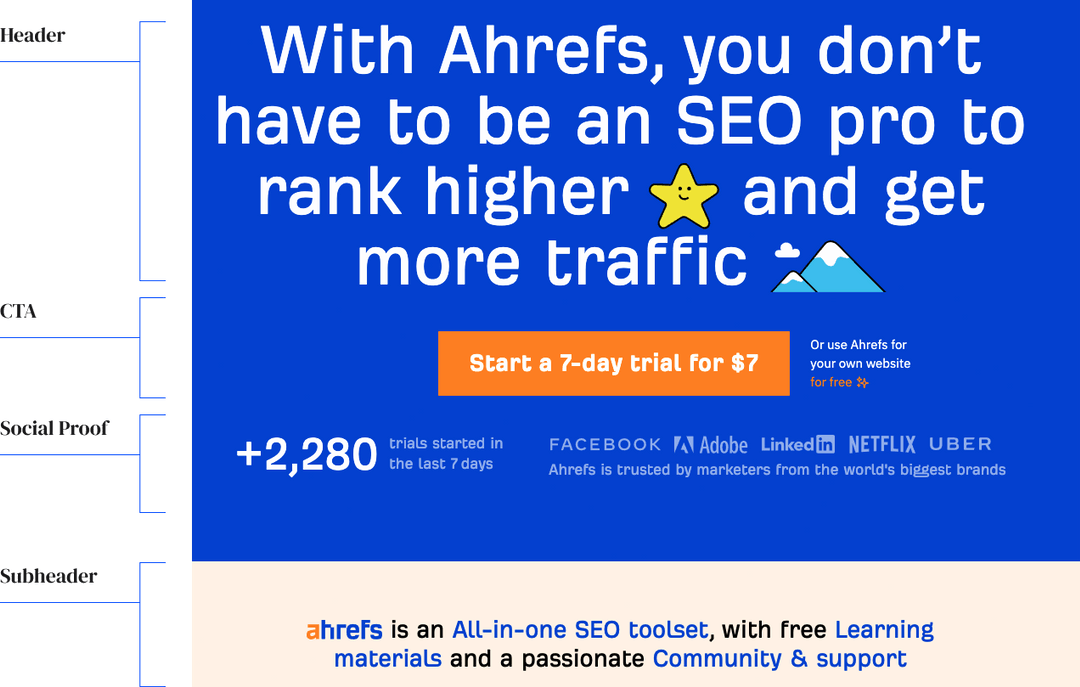
Ahrefs’ ATF section has four pieces that we’ll dive into individually: the header, call to action, social proof and a subhead.

Ahrefs' above the fold section has four pieces: header, call-to-action, social proof and a sub-header.

Image Credits: Demand Curve

A header that tackles the most common objection

Your header must hook readers with your most compelling feature framed as a bold claim. When you handle your target audience’s biggest objection, it can serve as the bold claim that gets visitors to continue reading.

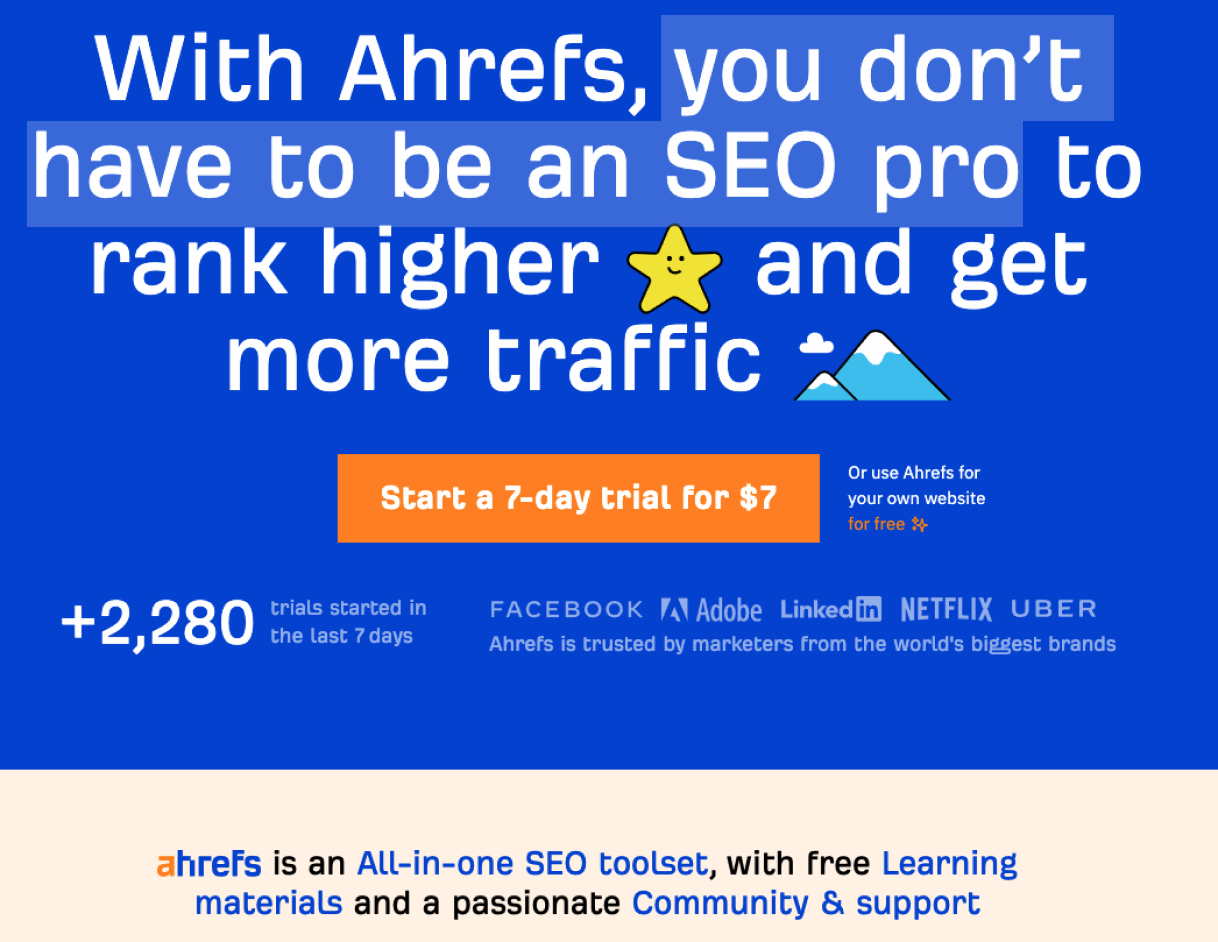
Ahrefs uses a common header template: Get [benefit] without [problem]. In this case, it’s flipped: With [product] you won’t have [problem] in order to get [benefit].

Ahrefs knows a lot of businesses need SEO but don’t have the time or resources to build expertise. So, Ahrefs tells their visitors you don’t have to be an SEO professional to use its product.

The underlying benefit here is that users will get more search traffic and rank higher on the web while not needing SEO expertise to do so.

Ahrefs tells their visitors you don't have to be an SEO pro to use their product.

Image Credits: Demand Curve

Make your call to action stand out

Calls to action (CTAs) are the only way to move visitors down the relationship funnel. It’s nearly impossible to get someone to sign up without encouraging them to do so. Visitors instinctively don’t want to sign up.


Demand Curve: How Ahrefs’ homepage educates prospects to purchase published first on TechCrunch
from Tumblr https://jillfleisher.tumblr.com/post/671187222931849216

Monday, December 20, 2021

Demand Curve: Avoid these 10 copywriting mistakes to get more conversions

Copywriting isn’t just about combining the right words to sell your product — it’s how your messaging connects with users. By improving a few words, your copy can better convince people to become customers.

At Demand Curve, we’ve helped thousands of startups get traction with their first customers and scale their growth. Along the way, we’ve noticed several common conversion mistakes on landing pages, ads, emails and elsewhere that make your copy less persuasive.

For better results, here are 10 common copywriting mistakes to avoid, plus, how to fix them.

Writing in passive voice

Whenever possible, write in the active voice. It emphasizes the subject of a sentence and generally makes your copy shorter and easier to follow.

Consider the difference between these two sentences:

  • Resolve all of your urgent issues with our product. (Active)
  • All of your urgent issues can be resolved with our product. (Passive)

In marketing copy, active voice is especially important for describing your product benefits. Write them as action statements with your customer as the main character. Framing them in this way, rather than as things or experiences they receive, makes your product benefits easier to visualize.

Here are a few examples:

  • Netflix: Watch anywhere. Cancel anytime. (Not “Content can be watched anywhere. Your subscription can be canceled anytime.”)
  • Goodreads: Meet your next favorite book. (Not “Your next favorite book is waiting to be discovered.”)
  • Mint: Put an end to late fees. (Not “Late fees will end.”)

For more impact, use vivid and descriptive verbs.

Generic wording

Writer and literary critic F. L. Lucas famously suggested “writing to serve people rather than impress them.” Yet many copywriters use generic phrases like “#1 software,” “the best platform,” and so on to impress readers without actually providing helpful information.

As Lucas says, your copy should serve readers. This is best done by adding specificity. Avoid using generic wording, like hyperbolic claims, and instead speak to your readers’ exact needs.


Help TechCrunch find the best growth marketers for startups.

Provide a recommendation in this quick survey and we’ll share the results with everybody.


Here are a few ways to add more specificity to your copy:

Address the objection most relevant to your target persona

Anticipate and then respond to how prospects might push back against your offer. Example: Audible promises “A friendly email reminder before your trial ends” — offering peace of mind to people wary of unexpected subscription charges.

Use the second-person point of view

Relate products directly to your audience. Example: “We’re always talking to couples like you,” the wedding planning company Zola’s about page says. “You two are the heart of everything we do.” This makes Zola’s copy feel more like a personal conversation than if it were to refer more broadly to brides and grooms in the third person.

Incorporate examples

Think of scenarios where your product might be used, or how real customers benefited from your product. Examples help your prospect understand how your product fits into their world — notice how the examples in the last two bullet points provide a detailed point of reference for how to apply our tips.

No defined goal or outcome

Complex products often have a long sales cycle because there’s so much information prospects need to digest. This can result in copy that lacks clear next steps.

Effective copywriting moves people toward action. After all, it’s written for the sake of persuading. If there’s no outcome, it’s not copy; it’s literature.

To avoid this trap, work backward from your desired outcome: What you’d like your audience to do after reading your content. Make each sentence move the prospect closer to taking action.

The HR software company Gusto provides a good example here, using copy like:

“Our plans were built to fit your unique needs. Let’s start with a few quick questions.” — Two CTA buttons appear below this copy. One kickstarts a questionnaire; the other (“Learn More”) directs users to a detailed product page.

“Let’s find the right plan for your business.” — Under this text, users are prompted with a “Talk to sales” button.

“Step 1: Pick a plan that works for your business and budget.” — Gusto links to its pricing page, which includes a comparison table of its products.

Misaligned motivation

We like to think of ourselves as rational creatures, but the reality is we’re not. This is especially apparent in our consumption habits: We often buy with emotion but justify our purchases with logic.

What does this mean for your copywriting? You should build your copy around your prospects’ underlying desires and emotional motivations.

For example, take a look at the headlines used on Wix and Squarespace’s homepages.
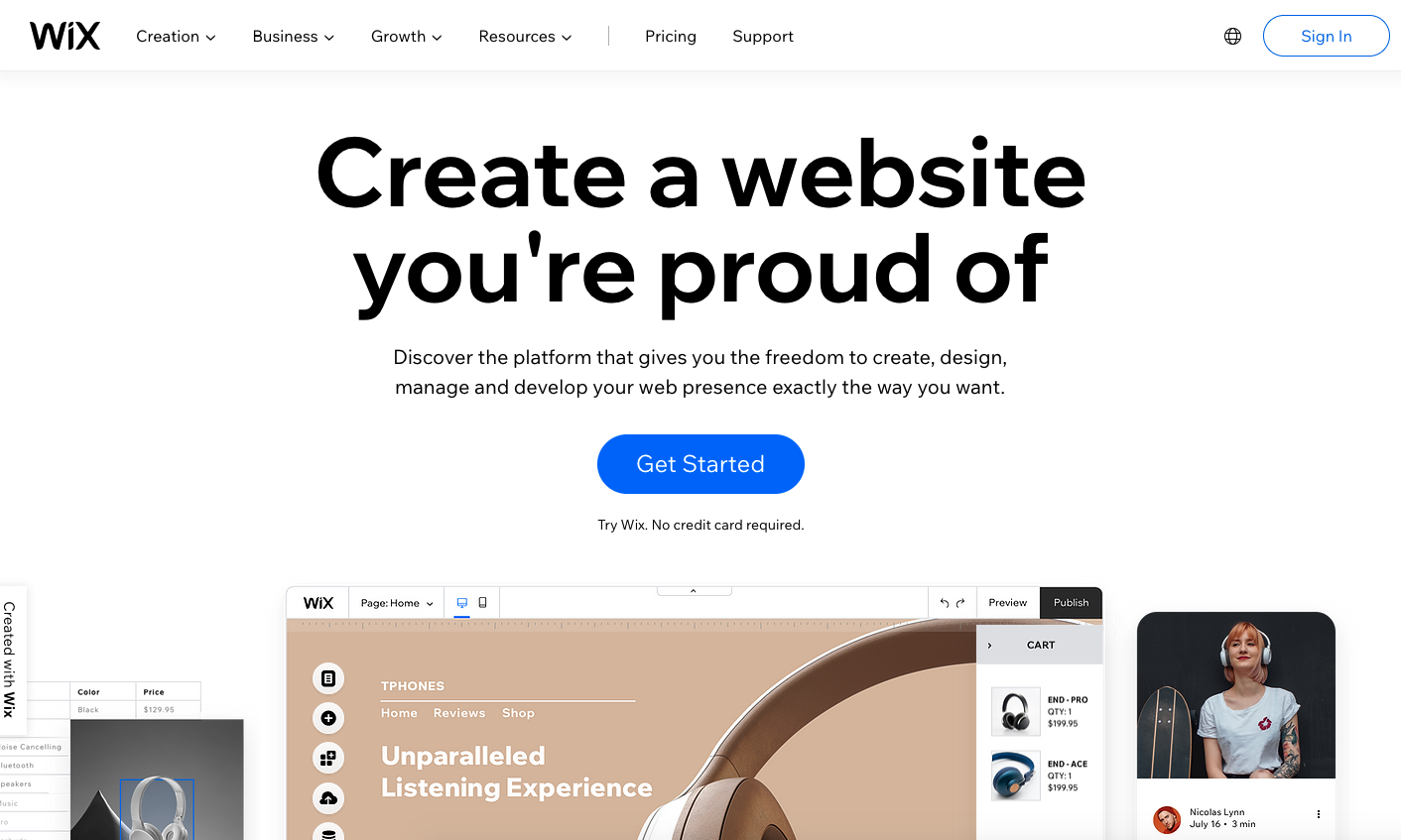
Screenshot of Wix's homepage

Image Credits: Demand Curve

Wix’s headline, “Create a website you’re proud of,” taps into users’ desire for not just a website but a website that looks good.
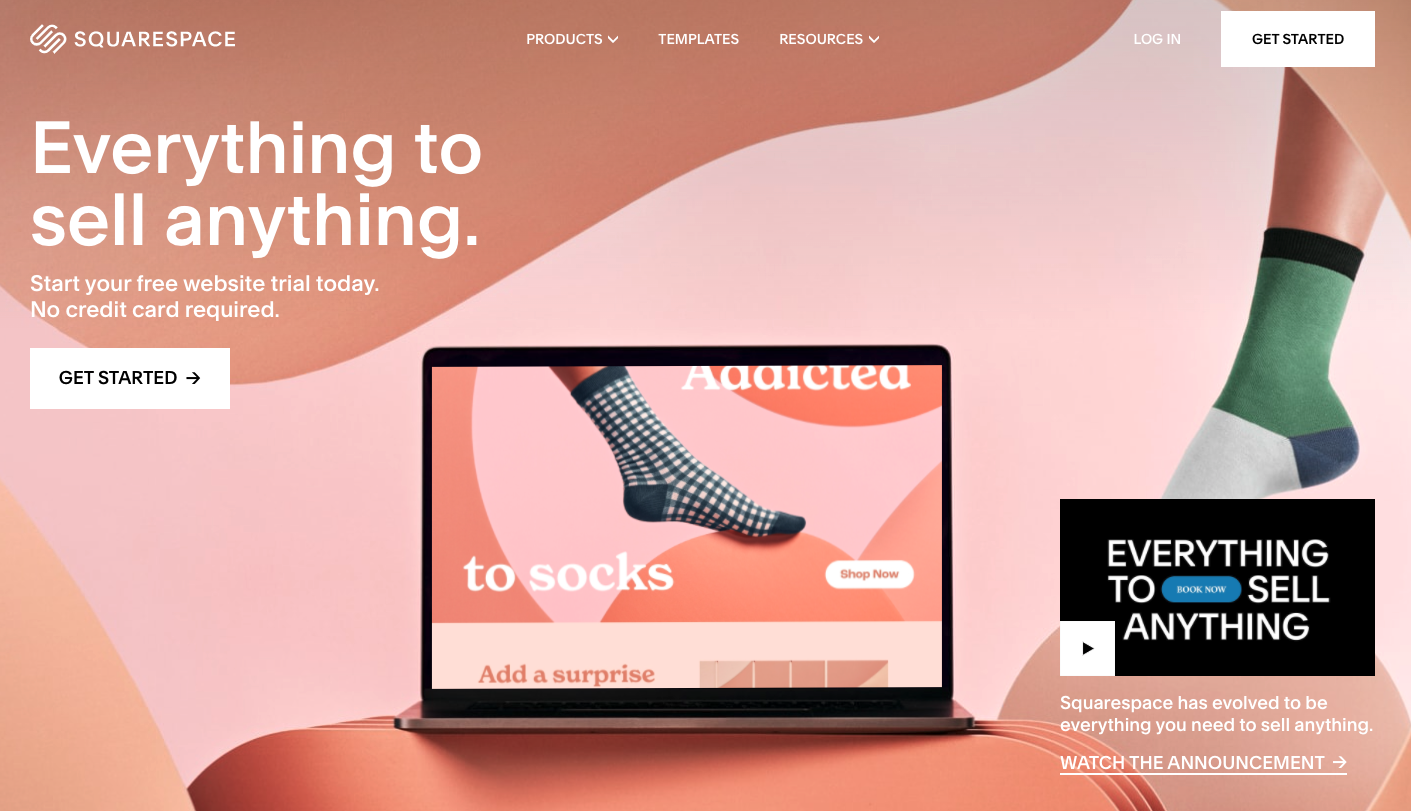
Screenshot of squarespace's homepage

Image Credits: Demand Curve

By comparison, Squarespace’s headline, “Everything to sell anything,” feels a lot less emotionally aligned with users’ goals. It’s trying to make the point that it offers a full suite of tools to sell any product or service (an example of using logical reasoning to persuade prospects).

But unless they own multiple businesses or sell a wide range of products, a lot of prospects might not actually need all those tools. Their bigger priority is creating an aesthetically pleasing site, which Wix immediately makes a case for with its headline.

Complicated wording and jargon

Readability describes how easy it is for someone to understand a piece of written text. When an article has low readability, it’s hard to understand and vice versa.

Why does this matter? Research shows that the average American best comprehends content written at the seventh-grade reading level — the level of the average 12- or 13-year-old. Text that crosses over into anything higher becomes less understandable.

Your copy should never confuse readers or make them feel dumb. No one wants to spend time trying to read something, after all.

Consider how analytics tool Hotjar communicates what its software does on its product page. It uses phrases like:

  • Understand how users really experience your site.
  • Visualize user behavior.
  • See where users click, move and scroll.

This kind of language is simple and easy to understand. It’s much more effective than phrases like “heatmapping and conversion funnel technology” or “website visualization software” — terms that can be overwhelming to readers new to analytics tools.

So write with the same vocabulary you’d use when talking with a 12-year-old. Use Hemingway App, Grammarly or a similar tool to judge the readability of your copy.

Long sentences

This relates to our earlier point about readability. Compared to long sentences, short ones are easier to understand. They also don’t take a lot of commitment to finish.

The fix here is to present one idea per sentence, and remove redundant words.

Take a look at these examples of short and punchy copy from around the web:

  • Morning Brew: Stay informed and entertained, for free.
  • HubSpot: Create delightful customer experiences. Have a delightful time doing it.
  • Tuft and Needle: See, feel and sleep on the difference.

Not speaking your audience’s language

Good copy communicates information, but great copy leaves a lasting impression. One way to make your copy resonate more with your target audience is to use their vocabulary.

One of the best examples of this is canine-centered subscription service BarkBox. It uses vocab like “zoomies” and “doggos” to speak to its target audience of enthusiastic dog owners.
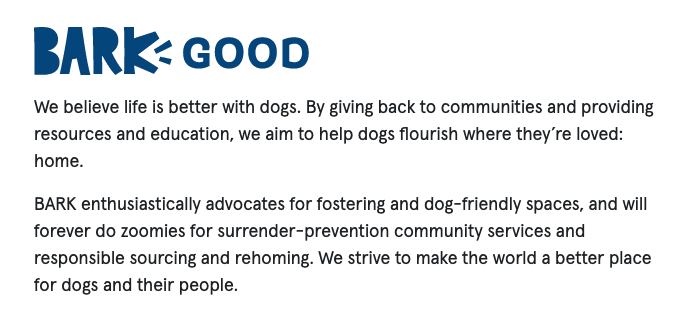
Barkbox uses vocabulary widely used by its target audience of dog owners

Image Credits: Demand Curve

Similarly, sports equipment retailer Brooks Running incorporates running lingo into its product copy. It highlights shoes best suited for “overpronation,” “neutral running gaits” and more terms specific to those in the running community, its target audience.

To learn your ideal customer’s vocabulary:

  • Check out Facebook groups, subreddits and other communities where your audience hangs out.
  • Look at sales calls, customer reviews and service tickets.
  • Interview prospects.

Make note of the unique words and phrases commonly used, and then incorporate them into your copy.

Weak headlines

Strong headlines invite people to keep reading. There are two defining traits that separate strong headlines from the weak:

  • They pique readers’ curiosity.
  • They promise some kind of value.

This applies not just to landing page headlines but also to email subject lines, blog post headers and more.

To write a more eye-catching headline, try one of the following tactics:

  • Create a sense of fear or urgency: “10 things you didn’t know could hurt your credit.”
  • Simplify a complicated or intimidating topic: “The minimalist’s guide to Bitcoin.”
  • Make its value obvious: “The best travel hacks that save you time, space and money.”
  • Acknowledge a common objection: “How to speak like a pro even with stage fright.”

No social proof

Readers can spot a sales pitch from a mile away, and they don’t like them. That’s because overt sales pitches often come off as one-sided or pushy. People are also skeptical that they may exaggerate or stretch the truth.

Adding social proof — evidence that other people value your product — prevents people from thinking your copy is pushy or fake. It lets others do the selling for you.

There are several other ways to incorporate social proof into your copy:

  • Use snappy lines from customer reviews as headers.
  • Mention how many customers you serve.
  • Quantify your results or benefits.
  • Call out the names of well-known customers that use your product, like influencers or major brands.
  • Mention any awards or top rankings your company or product has received.

Here are a few examples:

  • Wise: “We move over $7 billion every month and save people and businesses $3 million in hidden fees every day.”
  • Mailchimp: “Mailchimp was recently named one of the best global software companies of 2021 by G2.”
  • Headspace: “Join millions getting more mindful with Headspace. 4.9-star average rating. 611.9k ratings on iOS and Google Play. 70M downloads across all platforms.”

Emphasizing features

Some copywriters tend to focus on flashy product features, especially when a product involves revolutionary technology. These features are certainly important, but they don’t answer your prospect’s most important question: What’s in it for me?

So rather than emphasizing your product features, focus your copy on the benefit your customers will get.

For instance, Venmo’s website highlights all of the app’s unique benefits:

  • “Settle up with Venmo friends for any shared activity, from road trips to picnics to takeout.” — Feature: mobile money transfer with your contacts.
  • “Always pay the right person. There are a lot of John Smiths out there. Find the right one fast. No guesswork involved.” Feature: personal QR codes.
  • “Add personality to your payment notes with animated stickers, Bitmoji, and custom emojis.” — Feature: social feed.

To frame a feature as a benefit, try applying it to a real-life situation your customer might face. It’s not just about what provides value; it’s about how it provides value.

Recap

Pinpointing these common mistakes in your copy is the first step to improving your conversion rates. The next step is making the changes.

Here’s a quick recap of our recommended fixes:

  • Write with active voice.
  • Get specific with examples and use a second-person point of view.
  • Direct readers toward action.
  • Address your prospects’ underlying motivation.
  • Choose simple words over complicated ones.
  • Shorten your sentences.
  • Use your target audience’s vocabulary.
  • Write headlines that pique curiosity and promise value.
  • Leverage social proof.
  • Focus on product benefits rather than features.

Whether it’s your landing page, ad creative, email or something else, applying these fixes will help increase your conversion rates.


Demand Curve: Avoid these 10 copywriting mistakes to get more conversions published first on TechCrunch
from Tumblr https://jillfleisher.tumblr.com/post/671096640400211968

Wednesday, December 1, 2021

How to execute an amplified marketing strategy

Content marketers today face a constant struggle between keeping up with the volume of content they’re expected to produce and getting creative to produce rich, quality work that deeply impacts their audience.

Content marketing is recognized as a powerful tool, driving higher conversions than traditional marketing. However, the teams creating that content are using an outdated playbook that focuses on serving algorithms before audiences by constantly churning out posts targeting bots over brains.

An amplified marketing strategy fosters a connection between your audience and the expertise they’re seeking.

In an Accenture survey of more than 1,000 marketing executives across the globe, respondents were unanimous: Content overload is a top challenge. And 50% said they currently have more content than they are fully prepared to manage.

The strategies that made content marketing so riveting at its start haven’t evolved to meet the challenges of today’s marketers as they compete for their audience’s attention in a vast landscape of newsletters, podcasts, video series, blogs and social media.

With too much content to create or manage and too little time to measure its success or repurpose what they’ve already created, marketers need a new plan of action that puts creativity before quantity, audience before engine, and sets connection as the top priority. They need an amplified marketing strategy.

What is amplified marketing?

The amplified marketing approach puts captivating conversations at the center of your content strategy. Those conversations — with industry experts, customers, internal thought leaders, influencers and decision-makers — serve as the source material for all your marketing assets, streamlining your content creation, aligning your teams across channels and giving your audience the insights they’re seeking.

Amplified marketing turns to powerful metrics to identify what resonates with an audience and what’s not catching on. By extracting more value from the content they create and assessing its success, marketers can work more efficiently, effectively and creatively.

Help TechCrunch find the best growth marketers for startups.

Provide a recommendation in this quick survey and we’ll share the results with everybody.

Start with a conversation

Amplified marketing starts with a good conversation with someone who knows what they’re talking about on a topic your audience wants to explore. How do you do that? Bring the focus back to the audience.

Consider what questions they need answered, what new ideas they’re missing out on and what subjects excite or inspire them. Instead of developing a list of topics for content marketers to research and write about, put together a list of people who can offer your audience those answers, insights and big ideas.


How to execute an amplified marketing strategy published first on TechCrunch
from Tumblr https://jillfleisher.tumblr.com/post/669397959387054080

Thursday, October 7, 2021

Why generic marketing approaches don’t work on software developers

“Most of the technical content published misses the mark with developers. I think we can all do a better job,” author and developer marketing expert Adam DuVander says.

That was the very realization that led DuVander to share what he had learned about marketing to developers in two ways: He recently launched a book, “Developer Marketing Does Not Exist,” and also works through his consultancy, EveryDeveloper, which helps its clients, including Algolia, HelloSign and Stoplight, with technical content strategy and production.

DuVander was recommended to us by Karl Hughes, the CEO of Draft.dev, which specializes in content production for developer-focused companies. When we interviewed him last July, Hughes explained that he would refer leads to EveryDeveloper when they needed to sort out their content strategy.

Hughes was therefore happy to recommend DuVander via our experts survey. (You can share your own recommendations here!) “Adam draws from deep experience as a developer and developer advocate to make sure his clients set a winning strategy in motion,” he wrote.

This made us curious, so we got ourselves a copy of DuVander’s book and reached out to him for additional insights. The main takeaway? If you are reaching out to developers, you’ll absolutely want to avoid coming across as too promotional or too generic.

Here’s more:

Editor’s note: This interview has been edited lightly for length and clarity.

Why did you write a book titled “Developer Marketing Does Not Exist”?

Adam DuVander

Image Credits: Adam DuVander

Developer marketers certainly exist, because I work with them every day. The book title is a call to these marketers to treat their technical audience differently. To reach more developers requires more education and less promotion. Your “marketing” should not feel like marketing.

The idea for this book dates back to my time at ProgrammableWeb (2009-2014). Every press release looked the same. A company has a new API, but they haven’t bothered to explain why developers should care.

After ProgrammableWeb, I spent five years on the provider side in developer marketing roles. The book is a compilation of the philosophy I learned and created along the way. I hope the book helps anyone who wants to reach developers directly in an authentic way.

You mentioned reaching “the right developers.” What does that mean?

Every developer (the origin of our name) has a few basic needs, like clear documentation, help getting started and use cases to spark creativity.

The educational and inspirational content you use to attract developers will depend on who is the best fit for your product. If you provide a mobile SDK, the right developer is building iOS and Android apps. If your customers are data engineers, it probably won’t make sense to discuss front-end web technologies.

If the most common developer marketer mistake is being too promotional, the second is being too generic. Be specific with the best developer match for your product.

What are some arguments in favor of getting external help for developer marketing?

It’s tough for companies to see their own products the way someone outside that company does. Also, they may not have the development background within their marketing team to fully understand the audience.

In addition, hiring a full-time, experienced developer marketer can be difficult and expensive. An outside partner can provide better results, often for less than a full-time salary.

And what should startups keep in mind when picking these partners?

Look for that magical combination of technical skill and communications. The “education, not promotion” ethos should be obvious in the work they do.


Have you worked with a talented individual or agency who helped you find and keep more users?

Respond to our survey and help other startups find top growth marketers they can work with!


This brings us to EveryDeveloper — can you tell us more about it?

EveryDeveloper helps attract the right developers to our clients’ technical products. Our content strategy plans remove the guesswork and enable companies to produce content developers want to read.

There are about a dozen of us, split between content strategy and production. Most of the team can write code but prefer to write words about code.

Once we have jointly created a developer content strategy with a client, we’ll typically deliver two to four pieces a month.

What type of clients are best suited for the help you provide?

Anyone can benefit from fresh eyes on their developer experience and an objective plan to attract developers.

Those with a full staff of developer advocates or experienced developer marketers are best set up to execute on the plan we deliver. We sometimes work with unlaunched products, but usually there’s some initial success they are looking to amplify and improve. We also advise clients on how to build internal expertise.

All in all, we’ve helped companies from seed stage to Fortune 50 create better developer content strategies. The difference is whether it’s a product or an entire company that needs to reach more developers.

Do you have some recommendations for content and activities that you encourage companies to come up with?

EveryDeveloper focuses on content, which I believe is the most scalable way to reach developers. Blog articles are certainly core, but you want to make sure you’re covering the right topics in the right way. Don’t just publish to check a box. Make sure what you write has a strategic purpose and is something a developer wants to read. I think most developer-focused companies publishing multiple times per week would be better off with fewer, deeper pieces.

Other types of content include deep subject matter guides that barely mention the product (see the Developer Content Mind Trick) and all sorts of documentation.

Outside content, there’s events (in-person and virtual), advertising, sponsorships, open source and tools. I cover all of these in the book and the philosophy is the same: You’re more likely to attract developers when you aim to educate and inspire first.

What are some good targets for developer-oriented startups to sponsor? What should they keep in mind when it comes to sponsorship?

You want to use the same “education over promotion” philosophy even when you’re paying for the message. Developers are always skeptical, but especially with advertising.

Look for where your developers are already learning and getting their development news. If your sponsorship can feel as naturally helpful as other content from that source, you’ll be doing well.

I encourage developer marketers to think broadly about the sites, podcasts, events and tools they sponsor. Your best partner may not do any sponsorship yet.

In your book, you mention Netlify as an example others might want to follow when it comes to using tools as developer marketing. Could you sum that up? And why are acquisitions a good option in this context?

Book cover - Developer Marketing Does Not Exist - Adam DuVander

Image Credits: Adam DuVander

There are dozens of technology choices for content management and static site generation. That leads to hundreds of potential combinations and can be overwhelming for a developer that wants to build something new. Netlify recognized that problem and built filtered galleries to help developers choose the right tools.

It goes to show that developer-focused companies can recognize a problem their audience wants solved and build a tool to address it.

Better yet, look for existing tools that already have traction. Sponsor or even acquire them. I write about “the Runscope playbook” in the book, because they executed this strategy fabulously.

Do you have any final piece of advice to share with developer-focused companies?

Developer experience is foundational for developer-focused companies. They should continually look to improve the experience — both initial and ongoing. It takes a lot of effort and resources to reach the right developers, and too many companies send them directly into a poor experience.

You want to make it clear you have a product for developers, show what’s possible and get them started quickly.


Why generic marketing approaches don’t work on software developers published first on TechCrunch
from Tumblr https://jillfleisher.tumblr.com/post/664407589601345536

Tuesday, September 7, 2021

Performance marketing agency MuteSix bets on content and data to boost DTC e-commerce

Warby Parker filing to IPO last week was one more sign that direct-to-consumer (DTC) is an extremely powerful e-commerce trend. But LA-based performance marketing agency MuteSix didn’t wait that long to build its business around scaling DTC brands.

Created in 2014 and acquired by Dentsu in 2019, MuteSix was recommended to TechCrunch by Rhoda Ullmann, VP Consumer at Sense, a Boston-based startup building a home energy monitor. “They demonstrate best-in-class expertise with Facebook and Google paid ad platforms. They also have a very smart and efficient approach to creative development that was critical to helping us scale,” she wrote. (If you have growth marketing agencies or freelancers to recommend, please fill out our survey!)

Besides Sense, MuteSix’s former and current clients include companies such as Adidas, Petco, Ring and Theragun, to whom it provides a full range of marketing services, including top-notch direct response videos. But regardless of whether you can afford this, we think you’ll learn interesting lessons from our conversation with their CRO, Greg Gillman. The key takeaway? In today’s highly competitive ad environment, both content and data are kings.

Editor’s note: The interview below has been edited for length and clarity.

What can you tell us about MuteSix as an agency?

Greg Gillman

Image Credits: MuteSix

Greg Gillman: We’ve been around for about nine years. We started out as a Facebook ad agency — as opposed to a lot of agencies that start out by saying they do everything, we decided to focus on what we were really good at. At the time, it was doing Facebook media buying for e-commerce companies. Primarily here in LA, which is kind of the hub of these companies, but also all over. And then bit by bit, we grew the organization.

At this point, we’re a little over 400 people, and we manage upward of $500 million in spend on Facebook and Google, including Instagram and YouTube. What we’ve grown into is a one-stop shop for DTC e-commerce companies: We manage all the channels that a DTC brand needs. And we’re a performance agency; everything we do is based on results. People come to us to drive revenue into their e-commerce businesses.

Why do you think that performance marketing is the right fit for DTC?

DTC entrepreneurs are more focused on immediate impact, because if they’re not selling product, there’s no large brand propping them up. So I think that doing DTC marketing requires you to be more performance focused. For agencies that work with large brands, usually it’s more about impression buying versus performance buying. They can say: I did a reach campaign today to hit 10 million eyeballs, and whatever happens happens, because at the end of the day, you just told us to do 10 million impressions. It’s different than working with a group like us that’s trying to optimize every small piece of the funnel, and being accountable for the entire funnel to drive as much sales or revenue.

What type of clients do you work with?

The majority of the companies we work with are digitally native DTC companies. We’ve mostly stayed in that lane, because we’re really good at it. That being said, we work with companies of all sizes — startups, companies that are already established, and very large companies that need to rework both their creative and their media buying strategy.

I oversee sales, marketing and partnerships, and my role is really trying to figure out which brands make most sense to partner with MuteSix. We’re looking for high-growth brands that we can scale, and we’ve learned through the years that what works well are demonstrable products that have cool user value props.

We’ve worked with lots of startups at different points in the funnel, starting from the ground up and working with them through various rounds of funding, all the way through acquisitions, including two by unicorns. But these days, ground up is tougher. I like them to have some proof of concept — putting through $10,000-$15,000 per month on Facebook or $5,000-10,000 on Google usually shows me that there’s some life to it. But I don’t want to limit us if it’s a cool idea. I talk to a lot of people who come back once they’ve proven it out a little bit.


Have you worked with a talented individual or agency who helped you find and keep more users?

Respond to our survey and help other startups find top growth marketers they can work with!


What kind of clients are definitely not a good fit?

It won’t be a fit if there’s no real unique value prop for the product. If it’s just another run-of-the-mill company, a consultant can charge them a lower amount of money and set up Facebook ads, but what we are looking for are high-growth businesses.

The compensation for our campaign managers is actually tied to the performance of the campaigns, so if I bring a bunch of campaigns that we can’t scale, we’re gonna have a lot of unhappy media buyers who ask: “Greg, why would we take on this brand?” It’s a business model that has helped us attract top talent, but we need to make sure that we’re bringing brands that we think we can scale.

And it’s easier than ever to start a company, but it’s tougher now to scale it and take it past the $2 million-$3 million run rate. So I always revert back to asking founders: What are five reasons why people want to buy your product? What are the five reasons that they don’t? If the entrepreneur has trouble answering this, it’s not going to work. If they can’t tell somebody why their business is good, then we’re not going to be good at selling it.

How is MuteSix different from other agencies?

I’d say the main difference is that we have a 70-person in-house video creative team; and what we’re really good at doing is shooting and coming up with performance content. Not just content that looks and feels great, but video that is reverse-engineered to sell product.

Another key component is that we have a whole data science team that is also integrated with our media buying team, and that helps companies navigate things like attribution and signal loss due to the iOS 14 update. Right now, that means focusing on looking at the whole picture rather than by channel and working on mix-modeling attribution.

What are some of the things your data team focuses on?

One of the biggest things that brands struggle with is figuring out attribution, and how you continue to spend money even though you may have lost some signal into the platform. If Facebook skews too heavily, and Google is on last click, then sometimes it looks like things are never working. To help companies make informed business decisions, we are building statistical models that show information at higher-than-the-platform level.

We are also building better segments of customer profiles that help the clients understand who their core audience is, but also helps us build predictive audiences for finding new people.

Another big thing we’re trying to solve is incrementality. We work with large brands that have a strong organic following on social media; and their question is: “Hey, Greg, why should I spend more money if I would have acquired those users anyway?” So we’ve done incrementality testing with brands that spend a lot in other channels than Facebook and Google. We helped them build out different ways to look at the data so that we continue to spend in those channels and they actually know the incremental lift that they’re getting.

There’s one other piece that I think is super important and usually overlooked: first-party data. We work with brands to try and acquire as much of that first-party data as possible, segment it and use it, because that’s what they’d be left with if Facebook shut off tomorrow.

How do you prepare and adapt for changes in the marketing ecosystem?

Because we work with so many brands, we have a lot of senior leadership on each channel level. We routinely meet across departments and share insights. The data science team also builds pretty robust reporting. We try to stay ahead of our brands and to be forward-thinking about anything that is ultimately going to impact the agency. We’re constantly trying to hack our way through things like the types of content that work and things that we know will help us scale.

That’s how we have always approached it. Every major shift in our business was done to answer the needs of the brands that we were working with. For instance, there’s a data side to our business because it’s more important than ever to use that. Facebook used to be a platform where you could throw anything at the wall, and you would get a 4x or 5x return. No one’s asking about data when you’re literally printing money out of Facebook, right? It only happens when the margins get tight. But then Facebook became a more crowded platform, and the same happened with Google: more advertisers, higher CPM and a more competitive environment. We needed to be smarter about what we were doing, so we built out our data team.

Now there’s two levers that we can pull: the data side and the creative side of the business. Again, we are a performance marketing agency, focusing on all the levers. Because platforms like Facebook are only going to be more competitive, they’re only going to get more expensive, and we are only going to lose more traffic. So the more agile agencies have to think much farther outside of what we are doing on these platforms; because we’re going to make up the incremental revenue on things like SMS, influencer marketing and organic content, to continue to drive money into the top of the funnel.

Why is your content arm so important as a lever?

We have an integrated solution where our media buyers are paired directly with our video editors and producers to allow us to be agile and quick; because as everyone knows, content is king. What we try to do is optimize around things like what we call the thumbs-up rate on Facebook — three-second video views. If I held someone for that long in their newsfeed, I can potentially get them into our flow. We do the same on YouTube, and we do things like this on programmatic, because the name of the game is to get people into the funnel and work them through it. And we’re using both our data science team and our creative team to build out and optimize on the front end around these quick metrics to get things moving.

In my opinion, there’s no close second to an SMB agency that has a content arm like we do. Leveraging our content team to build performance content is one of the biggest levers that we have. Three and a half years ago, Facebook was telling us: “If you don’t build video content, and if you don’t prioritize video in the newsfeed, it’s not going to work.” At the time, we leaned in very hard — and the pain of growing a creative team of 70 people is real, especially in LA. But it’s allowed us to scale our agency.


Performance marketing agency MuteSix bets on content and data to boost DTC e-commerce published first on TechCrunch
from Tumblr https://jillfleisher.tumblr.com/post/661689646579908608

Friday, August 27, 2021

Making a splash in the marketing world

“There are three common blunders that most SaaS marketers make time and again when it comes to clarity and high-converting content,” says Konrad Sanders, founder and CEO of The Creative Copywriter, “1. Not differentiating from competitors. 2. Not humanizing ‘tech talk.’ 3. Not tuning their messaging to prospects’ stage of awareness at the appropriate stage of the funnel.”

In an oversaturated market, how can you differentiate yourself? This week in marketing, Sanders took the time to answer that, break down B2B SaaS marketing, and tell us how marketers can do it right. Anna Heim, Extra Crunch daily reporter, interviewed Robert Katai, a Romanian marketing expert, as part of our TechCrunch Experts series. If there’s a growth marketer that you think we should know about, fill out our survey and tell us why!

Marketer: One Net Inc.
Recommended by: The Good Ride
Testimonial: “Exceptional SEO expertise. My e-comm startup relies 100% on SEO traffic and three years ago we were delisted from Google because we didn’t understand about duple content. One Net fixed our site and optimized it for Google, which allowed us to get back into the SERPs. Bottom line is: They saved our business.”

Marketer: Natalia Bandach, Hypertry
Recommended by: Jean-Noel Saunier, Growth Hacking Course
Testimonial: “Natalia is someone with an out-of-the-box approach to growth drivers and experimentation, full of creative solutions and many ideas that she quickly tests through experimentation. Rather than focusing on one area, she tries to verify what makes the most sense to a business and designs experiments that are crucial not only short but also long term. She is an ethical growth manager, likes to know that the business brings real value and is ready to pivot in every direction, [which] she does fast, however, with a focus on the team’s well-being, professional growth and always avoiding burnout.”

Help TechCrunch find the best growth marketers for startups.

Provide a recommendation in this quick survey and we’ll share the results with everybody.

Marketer: Avi Grondin, Variance Marketing
Recommended by: Adam Czach, Explorator Labs
Testimonial: “They have a hands-on approach and worked with my team to not only drive results, but educate us on how we can grow our company further.”

Marketer: Nate Dame, Profound Strategy
Recommended by: Amanda Valle, Adobe
Testimonial: “They offered a robust content research, management and writing platform, which is enabling us to manage, produce and collaborate around our content better.”

Marketer: Oren Greenberg, Kurve
Recommended by: Michael Lorenzos
Testimonial: “He’s the most well-versed growth marketer I’ve met with a wide range of expertise and an uncanny ability to zoom in and out for business context and tactical implementation.”

(Extra Crunch) Are B2B SaaS marketers getting it wrong?: Konrad Sanders, a content strategist in addition to being the founder and CEO at The Creative Copywriter, wrote about SaaS marketing for Extra Crunch. He dove into what SaaS marketers are getting wrong, how to stand out in the crowded industry and the importance of how to approach each section of your funnel. Sanders says, “By creating content for every stage of the funnel, you’ll address your prospects’ concerns at the appropriate point in the buyer journey and increase the chances that when they do come to make a purchase, it’s with you.”

Romanian marketing expert Robert Katai explains how to get the most out of your content: This week, Anna profiled Robert Katai. Katai told her all about Romania’s startup scene and his views on repurposing content. When speaking about using content for carousels on Instagram and LinkedIn, he says, “The first slide should grab attention — it can be a question. The second slide can be a link to the interview so that even if people don’t click it, it will be on their minds. Then you can have slides with insights.” Read the full interview to find out what the third slide should be!

Tell us who your favorite startup growth marketing expert to work with is by filling out our survey.


Making a splash in the marketing world published first on TechCrunch
from Tumblr https://jillfleisher.tumblr.com/post/660715732667088897

Thursday, August 26, 2021

Romanian marketing expert Robert Katai explains how to get the most out of your content

There’s a lot of advice out there on how to grab people’s attention, but there’s one aspect of marketing that Robert Katai thinks isn’t talked about as often: maintaining their attention. The solution, he says, is a combination of content strategy and positioning.

Based in Romania, Katai is known for his podcasts and speeches covering the gamut of content marketing. A product manager at online graphic design platform Creatopy, he also works with clients as a freelance content strategist, and it is in this capacity that he was recommended to TechCrunch via our growth marketer survey. (If you have growth marketers to recommend, please fill out the survey!)

Katai was recommended by multiple Romanian clients and contacts who vouched for his content strategy prowess, so we were curious to know more. Who is he? And is his advice applicable beyond borders?

The short answer is yes. In a freewheeling interview, Katai spoke about how content marketing should integrate with users’ daily lives, and how content can be repurposed across multiple formats. He also shared some insights on the booming Romanian startup ecosystem.

Editor’s note: The interview below has been edited for length and clarity.

TC: How do you help your clients as a freelancer?

Robert Katai: One of the two things I’m doing is that I’m helping clients with creating their content strategy based on their objective. You can get web traffic, but you can also create a message and build the brand. You don’t have to start at the beginning; You can rebuild the brand later.

For instance, I’m working with a Romanian outsourcing company that started in 1993. They pioneered this industry in our city of Cluj-Napoca, but lately they started to realize that they should be more attractive from a sales as well as from an employee perspective. So I worked with them to perform an internal audit to see why employees love the company, why they leave, why they stay and what they want from the company.

Robert Katai

Image Credits: Robert Katai.

From there, I got to the idea that they needed to reshape their brand to not just have people notice them but to also maintain their attention. And here comes the content: I started an ambassador program, because there are people outside of the company who love it.

I also recommended they create an internal print magazine. It’s a very well-designed magazine that their 200 to 300 employees can take home and read. It’s not just about the job; it’s also about their hobbies, things to do in the city and some thought leadership articles that can inspire them to have a better life.

What’s the second way you are helping clients?

Apart from content strategy, I’m working with clients on their positioning for their audience, community and market, but also sometimes in terms of employer branding. Content can be a bridge between the two ways I am helping clients, because I’m using a lot of content marketing here and not focusing only on performance or growth marketing hacks. I’m helping them understand that if they want to establish a memorable, long-lasting brand in the market, they have to make content marketing part of their life.

If they want to reposition themselves in the industry, they need to say: Okay, these are the kinds of content we have to create for our goals; who will amplify the content, who will connect with us, and who will consume the content. Today, content creation is free — everybody can do it. The hard part is how you distribute and amplify that. And here’s how I can help the startups: Make a big piece of content and repurpose it in several small pieces; get it in front of people so that the brand is on their minds.


Have you worked with a talented individual or agency who helped you find and keep more users?

Respond to our survey and help other startups find top growth marketers they can work with!


How can brands achieve that top-of-mind status?

We all know that there are four kinds of content: Text, video, pictures and audio. These four formats never die. The platform can change, but the format will stay the same. A video can be an Instagram Reel, a documentary or something else, but it’s a video. The same goes for a photo. So the content strategy I’m working with is how brands can use that content ecosystem.

When I work with my clients — and also with Creatopy where I’m a product marketer — I recommend them to use content to build their brand and be visible to their users every day in their feeds. Every morning, when their customers are waking up and checking their phones, they don’t open a newspaper. They will open Twitter, Instagram or Facebook, and maybe then when they get out of the bathroom and make coffee, they will open YouTube and connect with Alexa.

I really believe that brands should create content that can just be in the mind of the user. Snackable content, Reels, TikTok … It doesn’t matter what we call it.

You also talked about repurposing content. Can you explain that?

Let’s take the interview you’ve done with Peep Laja. You could have recorded it as a video. And he covered several topics, so you could have several short videos — 30 seconds, three minutes, whatever. You can publish them daily on your site or social media channels with a comment that says, “Here’s the link to the full article.” But remember that on LinkedIn, that link will need to go into the comments section, not the post itself.

You can also have a longer video that you can publish on social media or on Wistia, asking people to give their email — so now you also have subscribers.

Then the second type of content you can create is audio. You already have it from the recording. You don’t have to publish the full 45-minute conversation, but you can have a five-minute audio clip, and again link to the articles.

Now we have video and audio, but what if you also designed quotes with his headshot and messaging? If it’s part of a series, you should also give it a name.

And it’s not just motivational; it’s educational, too, so you should take these quotes and create carousels for Instagram and LinkedIn. The first slide should grab attention — it can be a question. The second slide can be a link to the interview so that even if people don’t click it, it will be on their minds. Then you can have slides with insights.

The last slide will always be a call to action: Asking people to share, comment or save it for later — it’s the new currency on Instagram! And once you have your Instagram carousel, you create a PDF and publish it on LinkedIn.

So now you have five formats of content from one piece of content.

Wow, how much do we owe you?! Just kidding, we actually do some of that for the Equity podcast, for instance. Now, what other advice do you have for startups?

I’m a big advocate of documenting the process. Just imagine if Mark Zuckerberg had done that and you could read how he launched Facebook and so on. Noah Kagan is doing that right now. I think startup founders should do it, not just from the PR and marketing perspective, but for their audience. Even if your audience is not paying for your product right now, they are staying with you and giving your brand an essence in the industry.

Just think about what Salesforce is doing right now: They launched Salesforce+, which is like Netflix for B2B. It’s to get the attention of professionals and also maintain it, and I believe this is the currency of the big companies today: People’s attention.

Do you work with any startups in Romania? And do you have any impressions to share on the Romanian startup ecosystem?

Yes, I help a few Romanian startups with their content marketing and positioning. Sometimes other startups email me with questions, so I help them, too, but I don’t charge for email advice. I work with the ones that are looking for a long-term or project-based collaboration.

Startup founders here in Romania are curious, and very courageous to experiment even if it won’t necessarily work. And Romanian startups are very smart. For instance, Planable is doing a great job with content, social media and positioning. We also have social media analytics company Socialinsider, which this year launched virtual events, and TypingDNA, which wants to get rid of needing to log in with passwords and was founded by a former colleague.

I also found that the founders here work harder than their teams and don’t just leave others do the work — at least the ones I have met. We have several startup events in Romania: How to Web, and Techsylvania here in Transylvania.

I don’t like this name, but people say that Cluj-Napoca is the “Silicon Valley of Romania.” Lots of startups have been launched here, but the city that is getting more and more traction is Oradea, where the bet on education is paying off.

(If you are a tech startup founder or investor in Cluj or Oradea, fill in TechCrunch’s European Cities Survey 2021.)


Romanian marketing expert Robert Katai explains how to get the most out of your content published first on TechCrunch
from Tumblr https://jillfleisher.tumblr.com/post/660606264152358912

Wednesday, August 4, 2021

Hubspot CEO moving to exec chairman role as company promotes Yamini Rangan to CEO

Boston-based CRM company Hubspot announced today that co-founder and CEO Brian Halligan would be stepping into the executive chairman role and CMO Yamini Rangan would be taking over as CEO next month on September 7th.

Rangan joined the company in January 2020 after stints at Dropbox, Workday and SAP. Her strong background in engineering, sales and marketing should prove helpful as she takes over the chief executive role. It’s worth noting that Halligan suffered a snowmobile accident earlier this year, and while he has recovered now, Rangan ran the company in his absence, perhaps helping lay the ground work for this decision  Halligan wrote in a blog post announcing his decision that she is completely prepared to take on this role.

“Yamini has been overseeing day to day operations at HubSpot since March, managing Board meetings, the HubSpot earnings call, and key hiring and growth initiatives, working closely with Dharmesh and the rest of the leadership team. She’s made HubSpot better by being here, and I know that trend will continue with her as CEO.,” Halligan wrote.

Brent Leary, founder and principal analyst at CRM Essentials, who has been following the company since early days, says he isn’t surprised to see a change like this. “With the company recently hitting its 15-year anniversary it really isn’t a huge surprise that something like this is happening. And given all the success they’ve had in growing the company to this point, you have to believe they’ve been preparing for this move for quite some time,” Leary told TechCrunch.

The announcement came as the company released its Q22021 revenue, which looked to be pretty solid coming in at $310.8 million up 53% over the same period last year. The vast majority, over $300 million was subscription revenue with the remainder coming from professional services, a ratio that you would expect for a company like this. The revenue puts them on a nice run rate of over $1.4 billion.

The company was founded in Boston in 2006 by Halligan and Dharmesh Shah and raised over $100 million, according to Crunchbase data. It was an early promoter of content marketing, using quality content, often in the form of company blogs, to drive website traffic and increase sales. It’s something that’s widely accepted now, but when they started the company it was not well known and they helped bring the concept to the mainstream.

Hubspot later moved into a broader CRM platform after going public in 2014. Along with Wayfair, Hubspot is one of the big success stories to come out of the Boston startup scene and go public, helping to fuel the city’s startup ecosystem with the money the founders made on their successful IPOs. Hubspot stock was up over 2% in after market trading on the news, perhaps signaling that investors are pleased with the company’s transition plan.


Hubspot CEO moving to exec chairman role as company promotes Yamini Rangan to CEO published first on TechCrunch
from Tumblr https://jillfleisher.tumblr.com/post/658624440334221312

Tuesday, August 3, 2021

Demand Curve: Tested tactics for growing newsletters

There are very few marketing channels as well rounded as email newsletters. They provide a direct, owned line of communication with your audience; nearly 40x return on investment (~$40 generated per every dollar spent), are infinitely scalable and virtually free.

But to unlock these benefits, you’re going to need to be strategic. In this article, I’m going to share tactics we’ve used at Demand Curve to grow our newsletter list to over 50,000 highly-qualified subscribers and maintain an open rate of over 50%.

Increase popup conversion using the 60% rule

While they’re often thought of as intrusive, pop-ups work. On average, they convert 3% of site visitors, and strategic, high-performing pop-ups can reach conversion of about 10%.

To make higher-converting, less intrusive pop-ups, try the 60% rule.

  1. Choose a page you’d like to put a pop-up on. We recommend pages that aren’t conversion-focused (like product pages, checkout and sign-ups). We’ve found content pages work the best and they can act as a signal for visitors who are looking for something specific.
  2. Open your website’s analytics and see what the average time spent on that page is.
  3. Set your pop-up to appear after 60% of the average time of that page has elapsed.

So if the average time spent on a page is 50 seconds, set your pop-up to appear 30 seconds (60% of total time) after visitors land on that page.

Why 60%? Readers have shown interest in your content, but are nearing the end of their session. Prompting them to join your newsletter to see more relevant content in exchange for their email will feel fair.

To encourage new subscribers to open your welcome email, try breaking the welcome email pattern using delayed gratification and a recognizable sender.

Give samples of your newsletter to prove quality

If a visitor is new to your content, asking them to sign up for your newsletter can be a big step, and most new visitors won’t convert. To narrow the gap between a new reader and subscriber, provide a sample on the sign-up page. Use your most engaging newsletter as a sample to prove that your content is high quality.

To source your most engaging content, filter by open rate and replies. In your email service provider, sort your previous editions by open rate. This will help you identify which subject lines are most popular with existing readers. Modify your most popular subject line to turn it into a header on your newsletter sign-up page.

Next, go into your inbox and sort by replies to your newsletter. Identify which newsletter got the most replies from your readers. This is a positive signal that the content from that edition resonated the most and would be a solid choice for your free sample.

Give samples of your newsletter to prove your quality

Image Credits: Demand Curve

Emails from real people are opened more often

People reflexively ignore welcome emails after they sign up. But, those who do open your welcome email are more likely to consistently open your newsletters.

To encourage new subscribers to open your welcome email, try breaking the welcome email pattern using delayed gratification and a recognizable sender.

Delay your welcome email by 45 minutes. This will bypass the reflex that new subscribers have to ignore an email that pings them seconds after signing up. We’ve found 45 minutes to be ideal, because the delay is long enough that it breaks the pattern, but not so long that your email gets buried in their inbox.

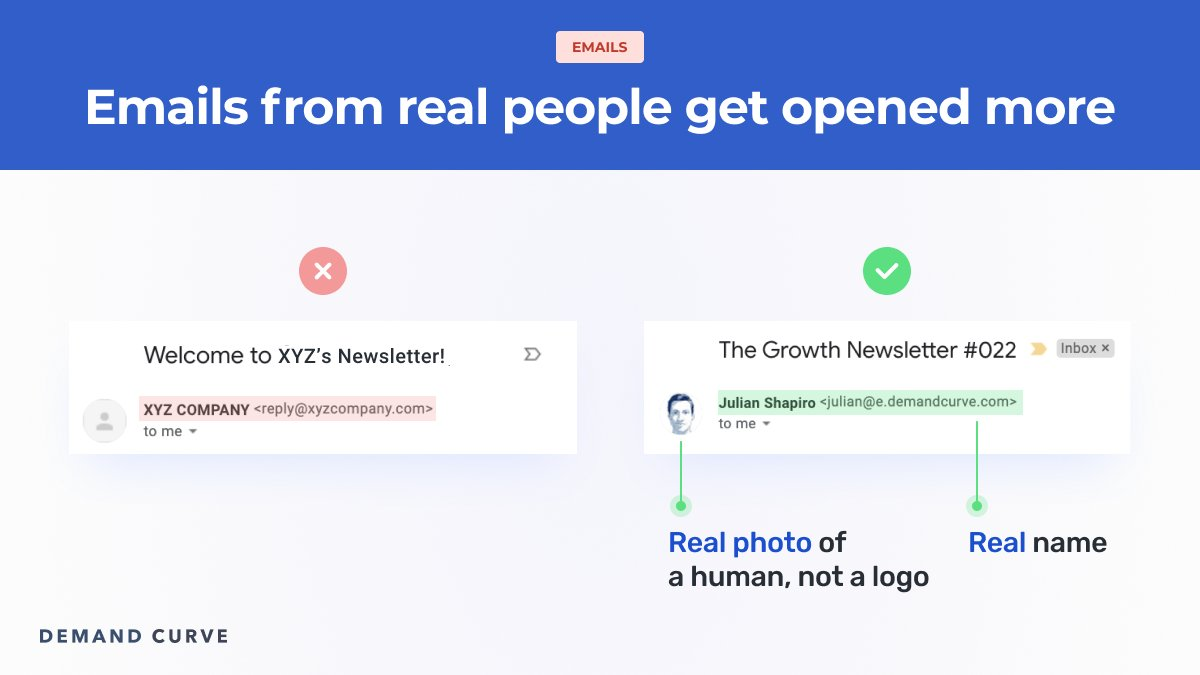
Send your welcome from a person, not from a business account. We’ve found this tactic to be especially effective when the sender is the founder of the business or someone with an established audience. Use a photo of that person and not your company logo to help the email stand out.

To avoid overflowing the sender’s real inbox, create a subdomain for your website that will be used exclusively for sending emails. Create an account for your sender and begin using it for your newsletter. This avoids overwhelming their inbox and maintains the health of your sending domain.

Emails from real people get opened more frequently

Image Credits: Demand Curve

Send a superissue to new subscribers

A new subscriber will be keen to receive their first issue. To ensure they’re satisfied, piece together your best content from past issues into a superissue. But be careful not to use the same content you included as samples on your sign-up page.

Send this first superissue with the welcome email so that your new subscribers are immediately receiving value from your newsletter. Starting with your best content first will get your subscribers excited to open future emails.

We’ve found that shorter welcome emails perform better than long-winded ones. Keep your welcome message short and your opening issue tight. Once they’ve received the welcome email and the first superissue, add them to the regular email cadence.

Send a super-issue to new subscribers

Image Credits: Demand Curve

Consider sending fewer emails

We polled over 24,000 marketers on Twitter asking whether people suffer from “newsletter fatigue,” causing them to unsubscribe.

The results: 80% of respondents unsubscribe when they get too many emails.

To avoid overwhelming your subscribers:

Give your subscribers control over how often they are emailed: Some subscribers want them weekly, while others want monthly. In the footer of your email, create opt-out links that allow subscribers to customize the cadence they’ll receive emails. Giving them the opportunity to opt out of frequent emails while still remaining subscribed keeps them as valid contacts on your email list. You want to avoid losing them completely as a subscriber.

Send fewer emails: Putting a constraint on how many emails you’re allowed to send every quarter will force you to be more thoughtful about the contents of those emails. A high volume of emails just for the sake of being in your subscribers’ inbox can burn you and your readers out. We’ve seen very little correlation between volume of emails and the resulting conversion rate.

Make your emails fun — not just educational

Most emails in your inbox are serious. To stand out, consider injecting some lighthearted memes, jokes or interesting links from around the web.

We’ve found this tactic works extremely well, because it gives your readers a dopamine hit in every email. Not every piece of newsletter content you write will resonate with every subscriber. Humor, on the other hand, can have broad appeal. Including interesting and fun content will ensure that every reader is left feeling satisfied.

It also helps build a habit. If every edition is slightly different, your reader will never be sure what they’re opening when a new edition hits their inbox. We’ve found that including something fun at the bottom of the newsletter gives readers a reward: Read the serious stuff, then get rewarded with the fun stuff.

We add a meme to each issue. People reply to tell us how much they appreciate it.

Add a funny meme or interesting content to engage your readers

Image Credits: Demand Curve

Make referrals seamless

Referrals are a free way to grow your newsletter. To increase the chances of subscribers referring you to others, make sure the process takes no longer than 25 seconds.

Remind readers at the end of each issue that they can refer others. A simple way is to ask them to forward the email to a friend who would find it interesting. Include a short sentence in the intro to your newsletter telling people being referred where they can subscribe. Include a link.

An advanced tactic is to include a subscriber’s unique link to a referral program so they can track how many people they’ve invited. Give them the option to share through email or social media.

You should also have a web version of every issue so that your content can be easily shared outside of email. Most email service providers will automatically generate a web link that you can promote through social media or elsewhere. You can also copy the content and post it to your website as a blog post to generate traffic from search engines.

Consider providing rewards to those who refer your newsletter. Merchandise will likely only work as an incentive if your brand is well known or very unique. We suggest incentivizing referrals using exclusive content. Send a monthly bonus issue to subscribers who have referred five or more friends. This will keep your costs down and give your subscribers more of what they already want.

Note that you will need a critical mass of subscribers before referrals will prove to be effective. We’ve found the threshold is about 10,000 subscribers. But if your audience is extremely engaged or the community you serve is active, implementing a free referral program has virtually no downside.

How to turn followers into subscribers

Your subscribers will likely become aware of your content through a social media channel, but social media audiences are rented from the platform — you do not own a direct channel to communicate with them. Converting followers into newsletter subscribers is one way to control a direct line of communication and deepen your relationship with your audience.

When pitching your followers to subscribe to your newsletter, include a link in your bio. This may sound obvious, but many people don’t do it. When someone comes across your social media profile, make signing up for your newsletter the call to action. Otherwise, they’ll have no idea that you even have a newsletter.

You could also cut a Twitter thread or LinkedIn post short and tell people to subscribe for the rest of the insights. You probably don’t want to overuse this tactic.

Create an offer or unique piece of content that can only be accessed through the newsletter. This will motivate your followers to join your email list to get access to exclusive content or unique offers.

Recap

Getting new subscribers: Use pop-ups that are relevant and only to high-intent readers on your site. Provide proof of why they should subscribe to your newsletter with sample content. Make your welcome email stand out and front-load the first issue with your best content.

Keeping subscribers: To keep your subscribers wanting more, send fewer emails. Sprinkle in humor and interesting links to turn your newsletter into a habit.

Promoting your newsletter: Use exclusivity and offers to hook your social media followers into subscribing to your newsletter. Ask your subscribers to refer your newsletter to others to grow your subscriber base.


Demand Curve: Tested tactics for growing newsletters published first on TechCrunch
from Tumblr https://jillfleisher.tumblr.com/post/658530083420717056